
Juvenile Center Release Route
The Southwest Florida Regional Juvenile Detention Center is a Florida Department of Juvenile Justice secure detention facility. It holds youth while juvenile proceedings move toward adjudication, disposition, or commitment placement. Adjudication is the juvenile-court determination of the case. Disposition is the court’s order about placement, services, supervision, or another outcome. Neither term should be treated as an adult conviction label.
A youth may leave secure detention for home under conditions, a DJJ residential program, another authorized placement, or another court-directed setting. That movement is not documented through the public LCSO adult release feed. The official DJJ facility page provides navigational facility details. Case-specific information remains subject to juvenile confidentiality and the requester’s legal authority.
| Question | Correct channel |
|---|---|
| Is a youth still in secure detention? | DJJ or facility contact for an authorized person |
| What did the juvenile court order? | Juvenile court or counsel, subject to access rules |
| Was the youth sent to residential commitment? | DJJ case or probation contact |
| Is there an adult jail release record? | Not for this juvenile detention placement |
Confirm Authorized Juvenile Release
Begin with the youth’s assigned case contacts, not an open web search. A parent or guardian may already have a juvenile probation officer, court notice, attorney, or placement document. Counsel can explain which order controls. Facility staff can route an authorized caller, but they may first verify identity and relationship. Those limits protect the youth and should not be treated as proof that no record exists.
- Gather the youth’s full legal name, date of birth, juvenile case number if known, and the caller’s relationship or legal authority.
- Contact the assigned attorney, juvenile probation officer, or the detention center using the official number.
- Ask whether the youth remains in secure detention, moved to another DJJ placement, or left under a court-approved plan.
- Request the controlling court or DJJ document through the authorized process rather than asking for a public name list.
- Follow aftercare or reporting directions supplied by DJJ, counsel, or the juvenile court.
A release date for one youth cannot be calculated from a facility average. DJJ reports an approximate average stay for the center, but individual timing turns on court orders, detention review, case progress, placement availability, and the youth’s legal status. Treat an average as a facility statistic only.
Juvenile Release Confidentiality
Juvenile records have narrower access than adult booking records. A public adult site must not publish a youth roster, release list, booking image, or named case detail. The Lee Clerk court-record information explains that confidential case categories and documents have restricted access. It also describes request paths for public material, but that does not override juvenile confidentiality.
Authorized access can depend on role and record type. A parent, guardian, attorney, youth, agency, or other legally permitted person may have a route that the public does not. Ask the record holder what identity, authorization, or case number is required. If part of a record is restricted, use the lawful portion and direct procedural questions to counsel or the agency. Do not seek confidential youth facts from an unrelated source.
- Secure detention
- Short-term locked DJJ custody while a juvenile matter moves through court or placement decisions.
- Commitment
- A court-ordered DJJ residential placement after disposition.
- Aftercare
- Services or supervision that may follow a residential placement.
- Confidential
- Protected from general public access even though authorized people may have lawful access.
The distinction also protects accuracy. A youth can move from assessment to detention, from detention to a residential program, or back to the community. Each is a different step. Calling all of them “release from jail” erases the agency, court order, and access rules that define what happened.
Regional Juvenile Center Facts
DJJ lists the center as a 50-bed hardware-secure detention facility. Hardware-secure means physical security features control movement. It serves Lee, Hendry, Glades, and Charlotte Counties, so location at the Fort Myers center does not prove that the underlying case arose in Lee County. The responsible juvenile court and case team may belong to another served county.
The center is at 2525 Ortiz Avenue in Fort Myers. DJJ reports the approximate average stay as an operating measure. It is not a promise, maximum, minimum, or projected release date for a named youth. Only the case-specific court and DJJ process can answer that question.
The manifest image comes from the official DJJ center listing.
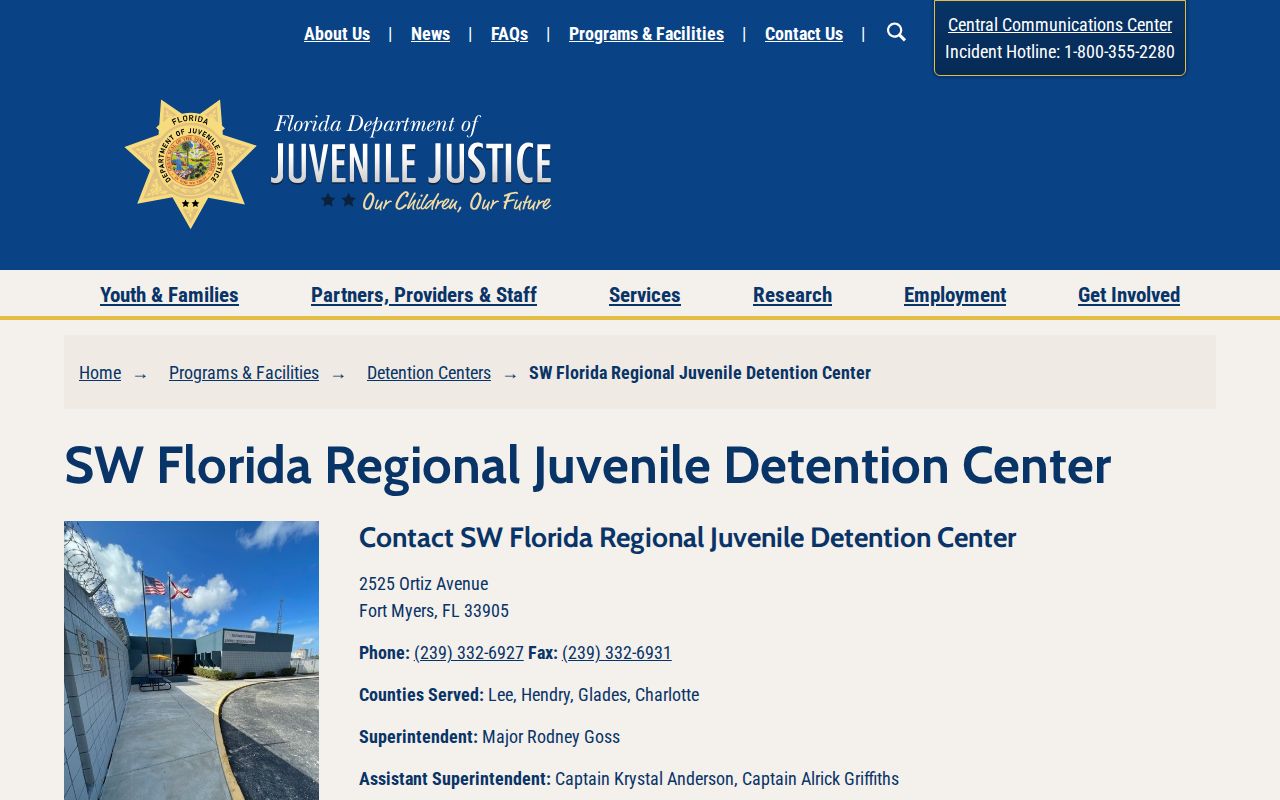
The listing confirms the facility identity and public contact route. It does not provide or authorize a list of youth.
Ortiz Juvenile Records Boundary
The Ortiz corridor places several facilities close together, but the legal systems differ. LCSO operates the adult Core Facility and Community Program Unit. DJJ operates the regional juvenile detention center and owns Fort Myers Academy, a separate residential commitment program. A youth at the detention center is not in the adult Core roster. A placement at Fort Myers Academy is not continued detention at this center.
Start with the exact facility name. The LCSO Corrections page identifies the adult county units, while DJJ identifies its youth programs. Physical proximity cannot substitute for the agency name. Nor can a move between youth settings be treated as release to the community without the court or DJJ transition information.
Fort Myers Academy serves a different program purpose. The Lee County Juvenile Assessment Center is also distinct because it is an assessment and booking point rather than long-term confinement. These boundaries help an authorized person ask the right office and keep confidential youth information out of adult public searches. Note: “Ortiz” alone does not identify custody, program type, or release status.
Juvenile Center Release Planning
Release from secure detention may lead to court conditions, supervision, services, placement, or a return to a parent or guardian. Details are individualized. Juvenile probation and counsel can explain what must occur next. Facility statistics cannot answer whether transportation, reporting, school, treatment, or another condition applies to a specific youth.
An authorized person should ask for written instructions and the next responsible contact. Confirm the date, destination, required arrival or reporting terms, and who may receive the youth. If an order changes, use the latest filed or agency-issued direction. Avoid relying on an adult booking search, informal message, or inference from a missed call.
For broader distinctions among Lee County adult and juvenile facilities, the Lee County facility and release overview maps each building to its record system without publishing confidential youth data. It can help identify the agency, but case-specific youth answers still must come from DJJ, juvenile court, or counsel.
Juvenile Center Contact
DJJ publishes the Southwest Florida Regional Juvenile Detention Center at 2525 Ortiz Avenue, Fort Myers, Florida 33905, with telephone 239-332-6927. Use the official facility number for routing. Staff may confirm only what the caller is authorized to receive. Have identity, relationship, and case information ready.
2525 Ortiz Avenue
Fort Myers, FL 33905
239-332-6927
DJJ secure detention center
Do not ask staff for a public release list or names of youth. Ask how an authorized person verifies a placement, transition, or court-directed release. When legal access is uncertain, contact counsel or the juvenile court. That approach respects confidentiality and produces a case-specific answer from the office that holds the record.
Because the center serves four counties, tell staff which county and court are tied to the case if that fact is known. A Lee County address does not ensure a Lee County case. The assigned juvenile probation officer or attorney can help identify the proper court and explain which orders an authorized person may receive.
If staff confirm that a youth moved to residential commitment, ask for the exact program and assigned contact. If the youth returned to the community, request the written transition or supervision directions through the lawful channel. Do not infer that legal control ended. A court condition, juvenile probation term, treatment plan, or later hearing may still apply after physical departure from secure detention.
Juvenile Release Record Checks
Keep copies of lawful notices and the latest instructions. Case dates can change, and a verbal estimate should not replace a filed order or current DJJ direction. When two instructions differ, ask counsel or the assigned case contact which one now controls. This prevents an old detention review date from being mistaken for a confirmed release.