
Lee County Parole Versus Probation
Leaving a Lee County jail does not show whether supervision continues. Probation is usually ordered by a court instead of, or after, a jail or prison term. Parole is a conditional release from prison under rules set by the Florida Commission on Offender Review. Florida parole eligibility is mostly confined to older offense cohorts and limited statutory groups. It is not the routine early-release path for a modern Florida sentence. Conditional release and community control are separate labels, so the exact record term matters.
| Lee County supervision type | Who controls it | Record to check |
|---|---|---|
| Probation | Sentencing court, with supervision commonly handled by FDC Community Corrections | FDC Supervised Population record and Lee Clerk docket |
| Parole | Florida Commission on Offender Review for an eligible case | FDC record, FCOR agenda, and signed Commission action |
| County pretrial release | Court and local pretrial program | Lee Clerk orders and Pretrial Services records |
| Federal supervised release | Federal court and U.S. Probation | Federal docket, not Florida FDC |
The release entry and supervision record mark different events. A booking marked released means LCSO stopped holding the person on that booking. It does not mean the court case ended, that all conditions were met, or that another agency has no authority. Start with the agency tied to the sentence and confirm the exact status.
Verify Lee County Release Supervision
The Florida Corrections Offender Network separates inmate population, inmate release, community supervision, and absconder records. Search All Corrections Offender Databases is the best first choice when the category is unknown. A DC number is the strongest identifier. With a name search, compare the full name, aliases, physical details, photograph, offense, county, and DC number before relying on a match.
- Search all FDC databases by DC number or full name. Do not stop at an inmate-population-only result.
- Open the Community Supervision match and record the exact supervision type, status, circuit, office, and termination date if shown.
- Match the offense and case number in the Lee Clerk court record. Read the filed probation, modification, violation, or termination orders.
- Use FCOR only when the record points to parole, conditional release, or another Commission category. An agenda listing is not the final action.
- Contact the office listed on the current FDC record when an official reporting or records question remains.
The official FDC Supervised Population search shows the fields used for a Lee County supervision check.
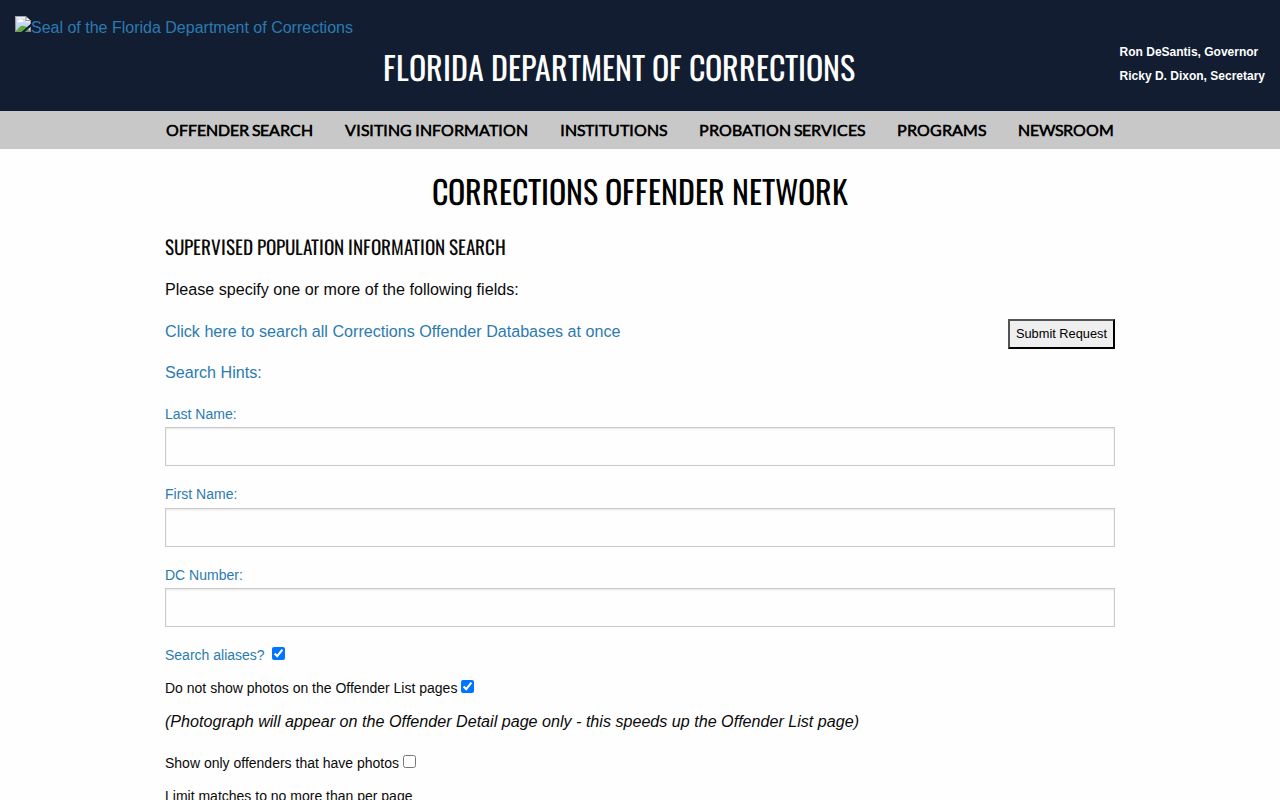
This interface is the state lookup for active or historical FDC community supervision, while the Clerk remains the source for the court's order.
Lee County Probation Office
Lee County is in Florida's Twentieth Judicial Circuit. The FDC Fort Myers Circuit Office serves Charlotte, Collier, Glades, Hendry, and Lee counties. That broad service area is why the nearest office should not be assumed to be a person's assigned reporting site. The live Supervised Population record controls the office assignment, and an assignment can change.
FDC Fort Myers Circuit Office
2295 Victoria Avenue, Room 133
Fort Myers, FL 33901
239-278-7240
ftmyers.cir@fdc.myflorida.com
General staff can route a records or reporting question, but they may limit personal details. Provide the DC number and exact record name. For a county pretrial or court probation issue that is not in FDC, use the Lee Clerk case number and the office named in the judicial order.
Note: Confirm the assigned office in the current FDC record before relying on a location near the Lee County Jail.
Lee County Supervision Terms
Florida records use short labels that can be easy to misread. The words describe a legal status, not the whole case history. Read them with the court order and agency record.
- Discharge
- The formal end of a custody or supervision term, as documented by the responsible agency or court.
- Absconder
- A person whom a supervision agency reports as having stopped required contact or whose location is not known.
- Conditional release
- A form of post-prison supervision within FCOR's statutory authority, distinct from ordinary parole.
- Community control
- A restrictive court-ordered form of supervision in the community.
- Detainer
- A request or notice that another authority may take custody or affect release.
A status can change after a hearing, corrected record, arrest, transfer, or completed term. Save the record's update date and seek the signed action when the result has legal importance.
Lee County Parole Hearing Records
The FCOR Commission Voting Schedule groups meetings by month and identifies votes, teleconferences, conditional medical release votes, and other sessions. A date-specific agenda may list a name, DC number, category, panel or full Commission, county, offense, and case number. The county field can refer to the case county rather than where the person is housed or plans to live.
An agenda is only a scheduled matter. It does not prove parole was granted or denied. For the result, request the signed Commission Action or order with the DC number and meeting date. FCOR records requests go to fcorlegal@fcor.state.fl.us, 4070 Esplanade Way, Tallahassee, FL 32399-2450, or 850-848-4460. The Office of the Commission Clerk is 850-488-1293.
Florida Statutes section 947.16 supplies interview timing for people who are otherwise eligible. It does not create parole eligibility for every Florida prisoner. The judgment, offense date, FDC record, and FCOR determination must be read together.
Lee County Supervision Warrants
LCSO's Top Fugitives page can include violation-of-probation, violation-of-community-control, and failure-to-appear matters. It is a curated wanted list, not a complete Lee County warrant index. A missing name proves nothing about active supervision or a warrant.
For state supervision, check FDC's Absconder/Fugitive database and then confirm the issuing authority. An absconder label means the agency alleges lost contact or noncompliance. It is not a new conviction. A court docket may show a violation affidavit, warrant, hearing, revocation, reinstatement, or termination order, each of which adds context that a list entry cannot provide.
Local pretrial conditions and state post-prison supervision also should not be blended. A person released by LCSO may report to Lee County Pretrial Services while a person on FDC supervision follows the office in the AO record. Federal supervised release belongs to U.S. Probation and the federal court docket.
Lee County Release Reentry Support
The LCSO Re-Entry Case Management Program works with people approaching release. Its published services include treatment referrals, help with identity documents, Social Security benefit reinstatement, bicycles, emergency kits, clothing, and other basic needs. The Community Program Unit also provides reentry and alcohol or drug treatment programming.
These services do not establish that a person was released or discharged from supervision. A program milestone is not a custody record. Verify release in the LCSO Arrest Search, then check the court or FDC record for any continuing Lee County parole or probation status. For a broader county release trail, the Lee County released inmate search explains how the jail, Clerk, and FDC records fit together.
The local program detail is still useful. It shows that practical preparation can begin before release while legal supervision may continue afterward. Treatment participation and reporting terms come from the governing plan or order, not from the mere fact that a service was offered.
Note: Reentry services can aid a transition, but only an agency record or signed order confirms release and supervision status.
Lee County Release Property and ID
Lee County Pretrial Services directs a person seeking property secured after arrest to the arresting agency or the Lee County Jail at 239-477-1500. That is a routing path, not a promise that every item will be handed back at the release door. The arresting agency may hold some property, while the jail may hold other personal effects tied to custody.
LCSO separately describes reentry help with identification, birth certificates, and Social Security cards. Identity-document support can reduce a practical barrier after release, yet it does not replace a state ID-issuing agency or prove that all documents are ready. Keep the property question and identity-document question separate when calling.
The official Lee County Pretrial Services material shows the local release and property guidance.
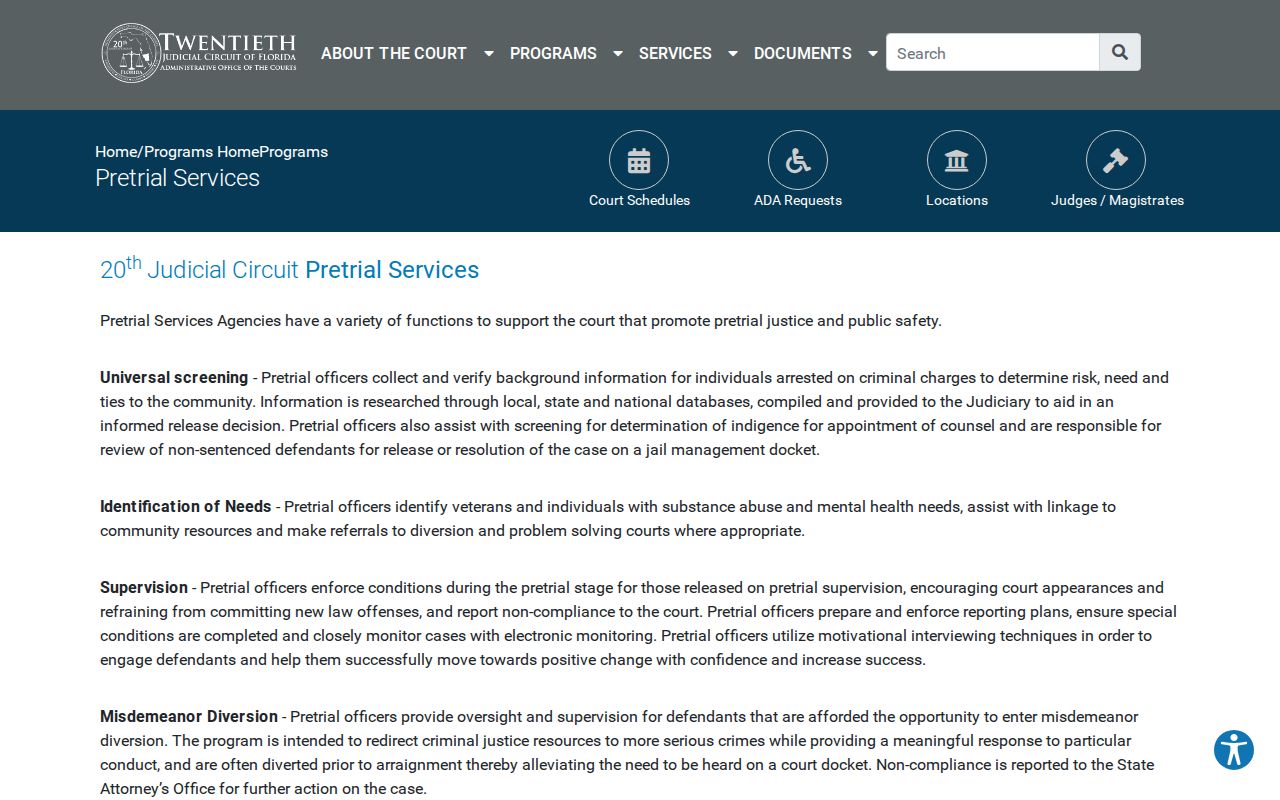
The captured guidance provides a local contact route while the supervision record remains the source for legal status.
Ending Lee County Release Supervision
Supervision ends through a documented event, not because a projected date passed or a name vanished from one screen. The FDC record may show a termination date or closed status. The Lee Clerk docket may contain a satisfaction, termination, discharge, revocation, or amended order. For an FCOR matter, the signed Commission action supplies the result.
Check the record after the expected end date and keep the exact status text. If online fields conflict, request the termination or discharge record from the agency that created it. FDC public records requests can identify the DC number and ask narrowly for supervision status and discharge documentation. A local case request should use the Lee County case number.
A jail release date answers when LCSO custody ended. A supervision discharge answers when the legal oversight ended. Those dates may be months or years apart, and a transfer can create another custody record between them.
Florida VINE remains a custody-notification tool, not a supervision-discharge ledger. An alert may report release from a jail or prison, but it does not establish that probation, parole, or conditional release ended. For that point, rely on the FDC supervision status, the court's termination order, or FCOR's signed action, depending on which authority controls the Lee County case.