
Core Facility Release Routes
The Lee County Sheriff’s Office operates Core with the Downtown Jail and Community Program Unit as one Corrections Bureau. Core has a distinct housing role, yet its public booking and release trail converges in the LCSO Arrest Search. There is no Core-only release list. A person can arrive from Downtown intake, move to another Ortiz unit, go to court, return to Core, or leave LCSO custody while the same booking episode remains the key identifier.
Do not infer discharge from a housing change. A transfer between Core and CPU is internal. A court trip is also not a release. When the booking says the person is no longer in LCSO custody, read the release entry and any destination shown. Community release can follow bond, a court order, time served, or dismissal. Transfer to FDC, another county, federal authorities, or ICE means custody may continue elsewhere.
| Core movement | How to verify it |
|---|---|
| Community discharge | LCSO release timestamp plus Lee Clerk docket |
| Internal move | Same LCSO booking; no new public roster |
| State transfer | LCSO exit followed by an FDC record |
| Other agency transfer | Follow the receiving custodian |
Confirm Core Facility Release
Start with a person-specific search. Recent Releases is useful for a new event. For an older booking, enter the name, date of birth, or booking number, set In Custody to No, and use a narrow Release Date Range. The result header shows name, birth date, booking, and status. Expand the matching entry. Compare identifiers and record the actual release date and time, charge, case number, bond fields, facility information, and destination if the live detail provides one.
- Open LCSO Arrest Search and choose Recent Releases or enter the strongest known identifier.
- Set In Custody to No when looking for a past Core release.
- Open the booking rather than relying on the result row alone.
- Match the case in the Lee Clerk court search and read the filed order or docket.
- If the record points to another custodian, search that agency before calling the event a community release.
A bond field can explain the mechanism for leaving jail, but it does not show final case disposition. Likewise, an LCSO status is about Sheriff custody. The home page’s Lee County release-record workflow provides the wider county, FDC, VINE, court, and federal sequence when Core’s entry needs another source.
Core Facility Release Records
LCSO warns that the online database is a courtesy, not a substitute for a Florida Chapter 119 request. Use Central Records when a historical record is absent, the public detail is incomplete, or documentary proof is needed. Identify the person, birth date if known, booking number, and a short date range. Ask narrowly for the booking sheet, custody movements, release date and time, recorded code or destination, and booking photograph when relevant.
14750 Six Mile Cypress Parkway
Fort Myers, FL 33912
239-477-1350
Monday through Friday, 7:00 a.m. to 5:00 p.m.; lobby opens at 8:00 a.m.
The LCSO records page links the request portal and lists $0.15 per page, with permitted extensive-use charges when applicable. Request costs do not decide whether a person is released. They concern copies and staff work. If the online entry lacks the judicial reason, ask the Lee Clerk for the order, judgment, sentence, dismissal, or termination record tied to the case number.
A released booking may remain visible even if a charge is later dismissed. The jail entry documents arrest and custody facts known to LCSO. It does not establish guilt or acquittal. That boundary is vital at Core because a person may have multiple cases, holds, or booking episodes. Match every record by booking and case number rather than relying only on a name.
Core Facility Housing Facts
LCSO describes Core as a 1,216-bed medium and maximum-security facility at the Ortiz site. It is the main housing location for women and the corrections system’s center for food, medical, and laundry services. Those operating facts explain its large role but do not create a distinct release process. The official LCSO Corrections page is the source for the custody level, capacity, and functions.
The official facility directory gives a county view of the Sheriff locations.
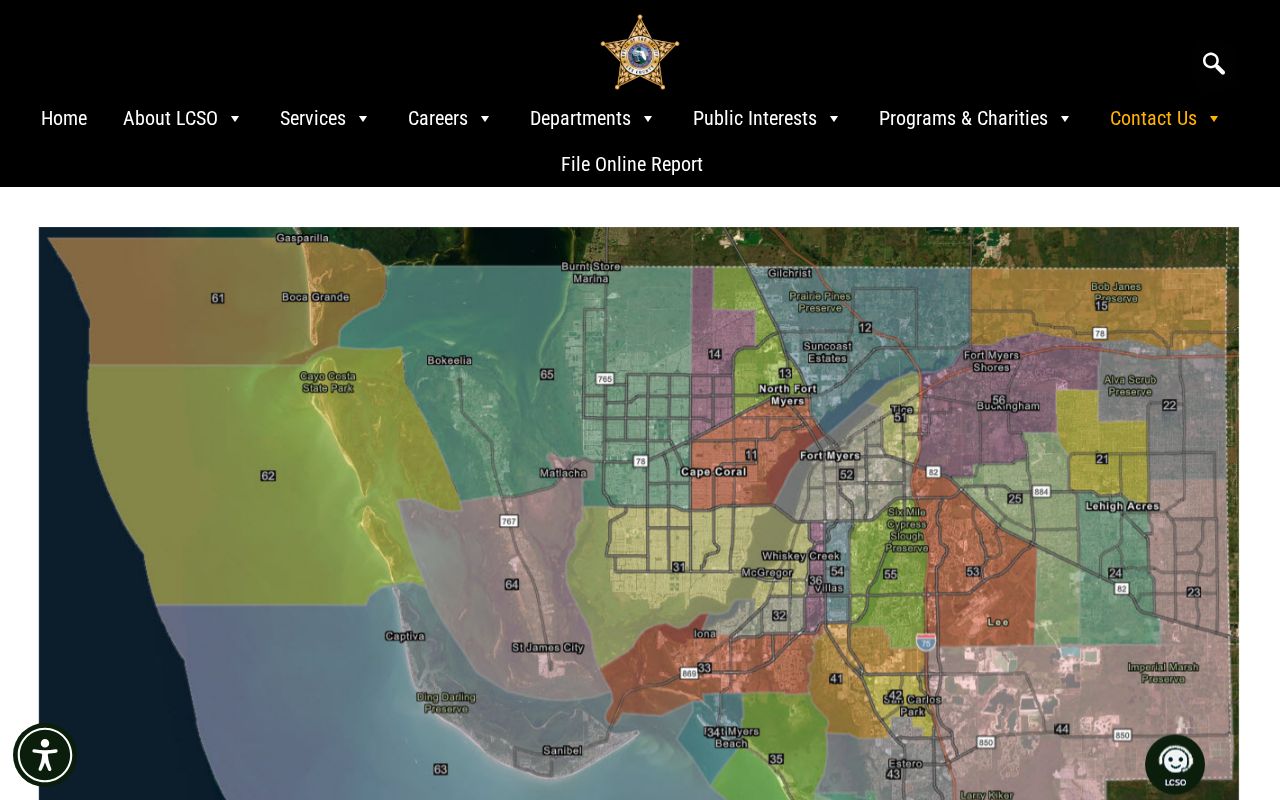
The directory helps identify the right building. A booking number remains the better key for tracing a Core release or internal transfer.
- Release
- An exit from the current custodian, which may be to the community or another agency.
- Discharge
- The documented end of a specified custody or supervision term.
- Transfer
- A change in unit or custodian while legal custody continues.
- Detainer
- A hold or request that may trigger a handoff to another authority.
Ortiz Release Records Differ
The Ortiz corridor contains adult LCSO units, the Southwest Florida Regional Juvenile Detention Center, and Fort Myers Academy at nearby addresses. Physical proximity does not combine their records. Core and CPU use the adult LCSO booking system. The juvenile detention center and academy operate through Florida DJJ, where confidentiality restricts youth information. Hearing “Ortiz” is therefore not enough to choose a search.
First identify the building and agency. An adult at Core belongs in the Sheriff workflow. A youth in secure detention or residential commitment does not. An internal LCSO move also should not be confused with placement in an adjacent DJJ program. The neighboring regional juvenile detention facility has an authorized-party contact route, not a public list of youth.
Use the facility name, booking or case number, and responsible agency together. This prevents a confidential juvenile matter from being searched as an adult booking and prevents a Core housing change from being read as discharge. Note: The Ortiz address alone does not identify the custodian or release-record system.
Core Facility ICE Handoffs
LCSO entered Task Force Model and Warrant Service Officer 287(g) agreements with ICE in March 2025. The Warrant Service Officer model permits trained local officers to execute administrative immigration warrants on people in agency custody. As a result, the last LCSO timestamp can be followed by immigration custody. It is not safe to treat every Core exit as a return home.
Research did not verify a separate ICE detention-services contract or an ICE facility at Core. The agreement concerns custody handoffs, not a new public Core roster. If the booking or case facts indicate immigration action, check the ICE detainee locator. Preserve the two events as separate facts: departure from LCSO and custody or later release under ICE.
Similar logic applies to FDC and other counties. Follow the receiving custodian’s record. An LCSO release entry remains valid for the Sheriff movement, but it cannot prove what happened next without the second agency’s source.
Core Facility Release Contact
The Lee County Core Facility is at 2501 Ortiz Avenue, Fort Myers, Florida 33905. Official LCSO pages have used 239-477-1700 for Core functions. Because LCSO pages have displayed jail and Corrections numbers in different pairings, preserve the office label when sharing a number. Call for routing and current custody questions. Use Central Records for a formal document.
2501 Ortiz Avenue
Fort Myers, FL 33905
239-477-1700
Core facility information
Ask a narrow question: is the person housed at Core, moved within LCSO, discharged to the community, or transferred to another custodian? Staff may route a records request elsewhere. For final court disposition, use the Clerk. For a transfer, use the receiving agency. That division keeps the Core release answer both useful and accurate.
Bring the booking number to every follow-up. If Core staff direct the caller to the Downtown intake function or Central Records, that does not mean the person was held Downtown at release. It reflects the shared LCSO system. Record the office name, date of contact, and exact terms used for the movement so that a later court or receiving-agency check can be matched correctly.
Florida VINE can provide a custody-change alert for county jail data. It is useful as notice, but LCSO remains the creator of the county movement record. If the person entered FDC, search the state corrections databases and match the new DC identity. If the person returned to the community under supervision, the FDC community supervision record may identify a status and office. Release from the building is therefore only one part of the legal path.
Core Release Verification Notes
Keep the booking number and case number with all follow-up notes. Dates can reflect different stages, so compare the agency label before deciding that two records conflict.