
Lee County 72-Hour Release View
The Lee County Sheriff’s Office does not publish a distinct page labeled “72 hours.” It operates one LCSO Arrest Search with Recent Releases, an In Custody option, and Release Date Range. The wider search is built by selecting the three calendar dates that cover the desired period. Each expanded booking must then be checked against the true hour-by-hour cutoff. That distinction matters near midnight and whenever the start time falls partway through a day.
A three-day window is best used as a catch-up view. It can find a Friday release when the search occurs on Monday, or an earlier event that no longer fits a same-day filter. The result still reports one booking episode. It does not establish that all court duties ended, and it may reflect a transfer instead of a return to the community.
The official Lee County release interface is shown below in the captured agency view.
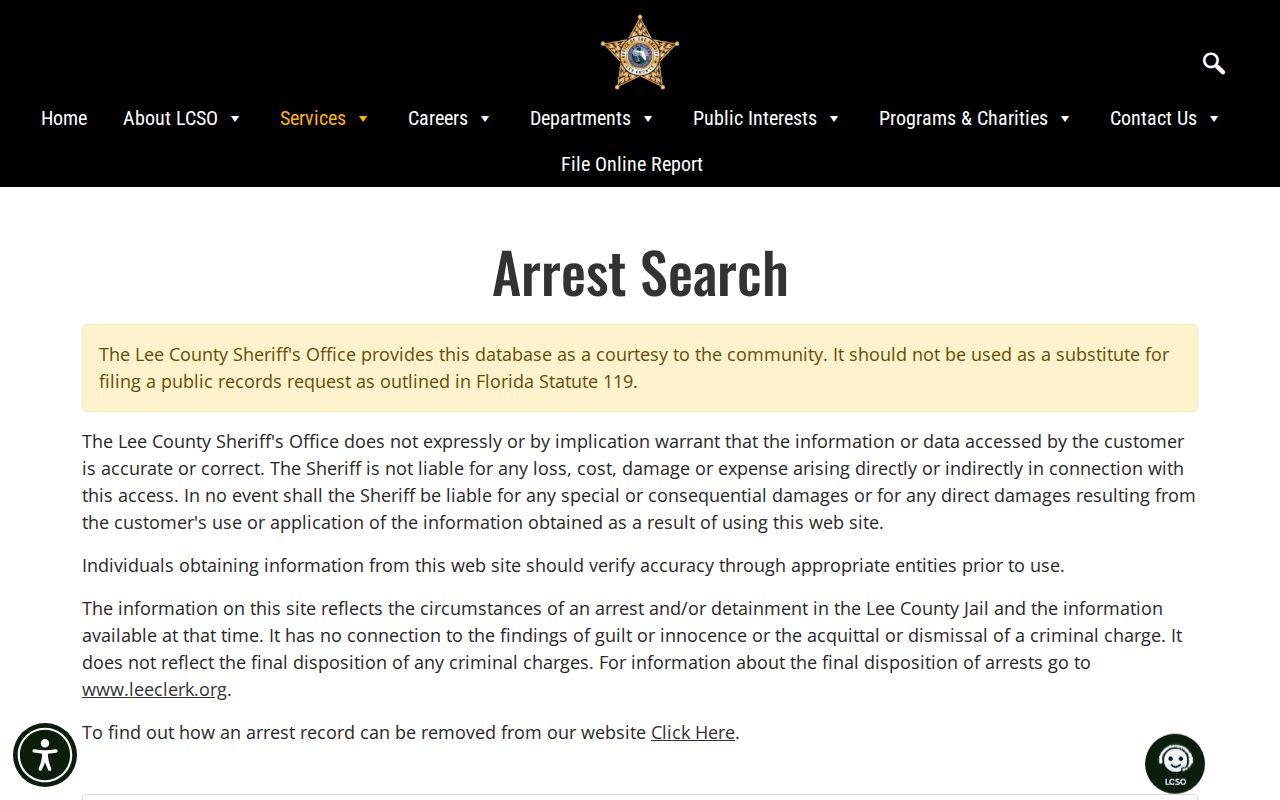
The filters in that capture are the same controls used for a multi-day release query, while the live details supply the timestamps needed to trim the results.
Check Lee County 72-Hour Releases
Write down the exact start time before entering dates. Then use an inclusive range broad enough to catch every date touched by the prior 72 hours. A query made late Monday, for example, may need Friday through Monday dates before timestamps are reviewed. The form permits a date span, while the release detail provides the exact time.
- Open LCSO Arrest Search and choose the Release Date Range control.
- Enter the start and end dates covering the full three-day period, including boundary dates.
- Set In Custody to No if it helps narrow results, then run the search.
- Open each result and exclude a release earlier than the exact 72-hour cutoff.
- Match name, date of birth, and booking number, and check any other booking for the same person.
- Use the case number to read court orders or disposition in the Lee Clerk system.
Do not count a person once merely because the name repeats. Multiple bookings are separate episodes and can have separate charges, release times, and destinations. Conversely, one booking may contain several charges. Count the booking event and read its single release movement rather than treating each charge as a separate release.
For a tighter current-day check, use the Jail Releases: 24 Hours method. The wider range should not replace a timestamp review.
Lee County Three-Day Release Fields
LCSO separates search fields from detail fields. The form exposes First, Middle, and Last Name, Date of Birth, Booking Number, In Custody, Booking Date Range, and Release Date Range. The results heading identifies Name, DOB, Booking, and Status. An expanded released booking may show identity details, release date and time, assigned unit, photograph, charges, arresting agency, bond details, court, case, and hearing information.
| Field | Use in a 72-hour review |
|---|---|
| Name and date of birth | Confirm the person and separate similar names. |
| Booking number | Track one custody episode and support a records request. |
| Status | Read whether LCSO now marks that booking in custody or released. |
| Release timestamp | Test the exact 72-hour cutoff after a broad calendar-date query. |
| Charge, court, and case | Connect the booking to its Lee Clerk file without treating the arrest record as disposition. |
| Bond | Provides release context when displayed, but does not resolve the case. |
Release reason or destination is not guaranteed as a universal field. Do not turn a blank into a guess. A status of no longer in LCSO custody also does not rule out FDC, another county, federal, or immigration custody.
Note: Use the exact words shown in the booking because “released,” “transferred,” and “not in custody” can describe different outcomes.
Lee County Weekend Release Checks
Weekends and holidays make the larger span useful, but they do not change how LCSO’s filter works. The search is based on calendar dates. A three-date selection is not always 72 elapsed hours, and an inclusive boundary may return extra records. Review the recorded time on every match. If the public detail lacks a timestamp or seems inconsistent, direct confirmation is safer than assuming it belongs in the window.
LCSO publishes no fixed weekend discharge timetable and no guaranteed web-posting cadence. A court-ordered release can take hours while the complete paperwork reaches the jail. A time-served release should take minimal time under the Corrections FAQs, but the public source does not promise a release door or a certain hour. Processing can also carry an event into the next date’s visible results.
A missing Monday result is not proof that no weekend release occurred. Search by the person’s name or booking number, widen the date range within the form limit, and use Central Records if the older entry is no longer clear online.
Lee County Release Range Limits
The Recent Releases shortcut is not a product labeled 24 hours or 72 hours. Live page code starts it on the previous calendar day and ends it on the next one. The separate Release Date Range accepts up to seven days per selection, and its picker displays ten years. Those interface facts show broad query capacity. They do not create a binding promise that every release will remain online for ten years.
LCSO states no guaranteed update cadence or public-web retention term. A current result can change through correction, and a historic booking can require a Chapter 119 request even when the calendar picker reaches its date. Underlying agency retention is different from website display. The search itself says it is a courtesy and not a substitute for a formal public-record request.
These limits are why a precise three-day list must be assembled, not merely accepted from the Recent Releases button. Select the right dates. Read each timestamp. Save the booking number, then go back to the record-creating office when the interface cannot answer the question.
A date picker is a query aid, not a record-retention schedule. A result that once appeared online may later need to be obtained from Central Records, and the office can respond with the public portions of the underlying booking or movement record.
Lee County Release Status Meaning
A three-day result proves an LCSO custody movement was recorded for the booking. It does not prove release from every system. If the destination is FDC after a felony sentence, search the Florida Corrections Offender Network. If another county had a hold, check that county. A federal transfer belongs with the responsible federal agency, and an immigration handoff belongs with ICE. The Lee Clerk case remains local even after physical custody changes.
| Record | What it answers |
|---|---|
| LCSO Arrest Search | Whether and when the booking left LCSO custody. |
| Lee Clerk case | The court order, sentence, dismissal, or later disposition. |
| FDC search | State-prison custody, release, or community supervision. |
| Florida VINE | Custody-change notices based on participating agency feeds. |
A bond release means the case can continue outside jail. Time served concerns the confinement addressed by that event. Neither term proves that another warrant, sentence, detainer, or supervision period has ended. Read the court file and the next custodian’s record before drawing a broader conclusion.
Confirm Lee County 72-Hour Releases
For a recent timing question, call the Lee County Corrections information line at 239-477-1500. Staff may direct the caller to Arrest Search or Central Records. For a written record, identify the person, date of birth if known, booking number, and approximate release dates. Request the booking sheet, jail custody movement, recorded release date and time, and any public release code or destination.
The Clerk supplies court disposition. FDC supplies state transfer and later release facts. Florida VINE adds alerts but is not the archival authority. A federal or ICE check is justified only when the booking, court file, or known destination points there. This sequence keeps the search tied to the agency responsible for each movement.
Keep the exact release timestamp with the booking number so a later check can distinguish the movement from the search run date.
- Release
- Exit from one agency’s custody, either to the community or another custodian.
- Transfer
- A handoff in which custody continues.
- Detainer
- A request or legal basis for another authority to take or hold the person.
- Disposition
- The court’s result in the underlying case.
For one named person whose release may fall outside this window, use the Lee County released inmate search and records path. A name search, booking number, and records request can reach beyond a three-day view.