
Lee County Projected Versus Actual Release
A projected date estimates when custody may end under the sentence and credits known at that point. Florida Department of Corrections public records label the field Current Release Date. Florida Statutes section 944.275 calls the underlying calculation the tentative release date. The page warning that the date is subject to change is part of the result, not fine print to ignore.
An LCSO release date serves a different system. It records movement out of Lee County Sheriff's Office custody and can mean community release or transfer to another custodian. If LCSO transferred the person to FDC, the county event and the future state release date are both valid but describe different custody stages.
Pretrial detention has no sentence-based projection. Bond, release on recognizance, dismissal, a plea and sentence, a detainer, or transfer can set the next event. A court calendar date is not a promised jail release date, and an expected paperwork date is not proof that processing is complete.
Find a Lee County Projected Release
Begin with the current custodian. The FDC Offender Information Menu covers state prisoners and FDC community supervision. It does not calculate the date for a person held only in Lee County Jail. A DC number is the best state identifier; a county booking number is not a DC number.
- Confirm whether the person is in LCSO custody, FDC custody, or another system. A transfer record points to the next custodian.
- For FDC, search by DC number when possible. Match identity, offense, sentence, and county before reading the Current Release Date.
- Save the record's current date and subject-to-change warning. Review sentence and minimum-term fields rather than copying the date alone.
- For a sentenced Lee County jail inmate, obtain the judgment and sentence from the Clerk, including credited time, then ask LCSO for its official custody calculation.
- Confirm the completed event in the later release record. A notification can prompt a check but does not replace that record.
The official FDC population detail shows where a Lee County state prisoner's date appears.
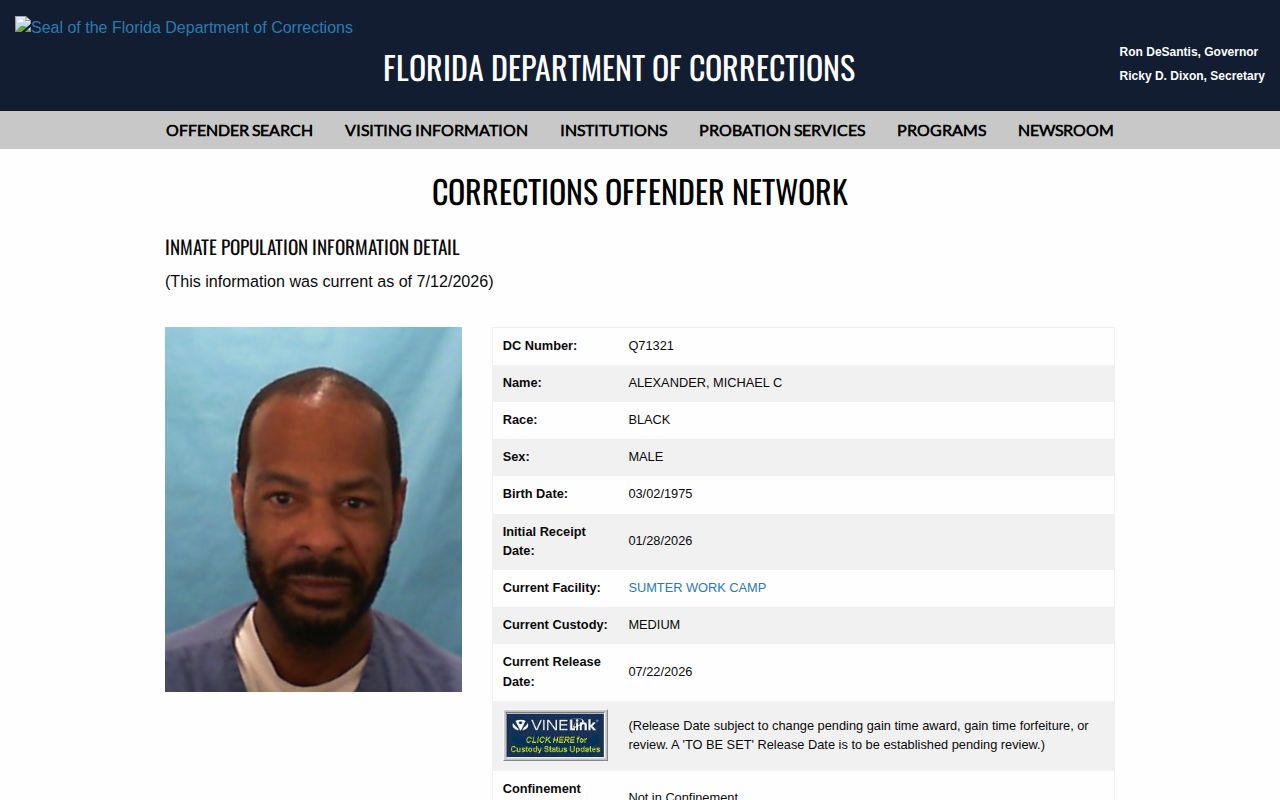
The image preserves both the public field label and the warning that the displayed calculation can change.
Florida Gain-Time Release Calculation
FDC starts with the sentence structure and lawful jail or prison credit. It establishes a Maximum Sentence Expiration Date for a term-of-years prisoner, then applies authorized gain-time to form or adjust the tentative date. A gain-time award or restoration can move the tentative release earlier. A forfeiture can move it later. The tentative date cannot extend beyond the maximum expiration date.
For the cohort governed by Florida Statutes section 944.275 for offenses committed on or after October 1, 1995, FDC may award up to ten days per month of incentive gain-time. Gain-time cannot produce release before at least 85 percent of the sentence imposed has been served. Court-awarded credit for time physically held counts toward that floor.
That rule does not promise a 15 percent reduction. Gain-time must be earned under law and agency criteria, can be forfeited, and is unavailable for some offenses. A mandatory minimum, life sentence, prison-releasee-reoffender term, or other sentence rule can require more than 85 percent or the whole term. Older offense cohorts have different statutory limits. A simple sentence-times-0.85 calculation is not reliable.
The governing cohort follows the relevant offense and sentence dates. Section 944.275 contains different monthly limits for offenses before January 1, 1994 and for those between January 1, 1994 and October 1, 1995. A decades-old Lee County sentence cannot be recomputed from a short web summary. The judgment, dates of offense, jail credit, sentence structure, and FDC calculation are all needed.
The official tentative release and gain-time statute is the source for the statewide framework.
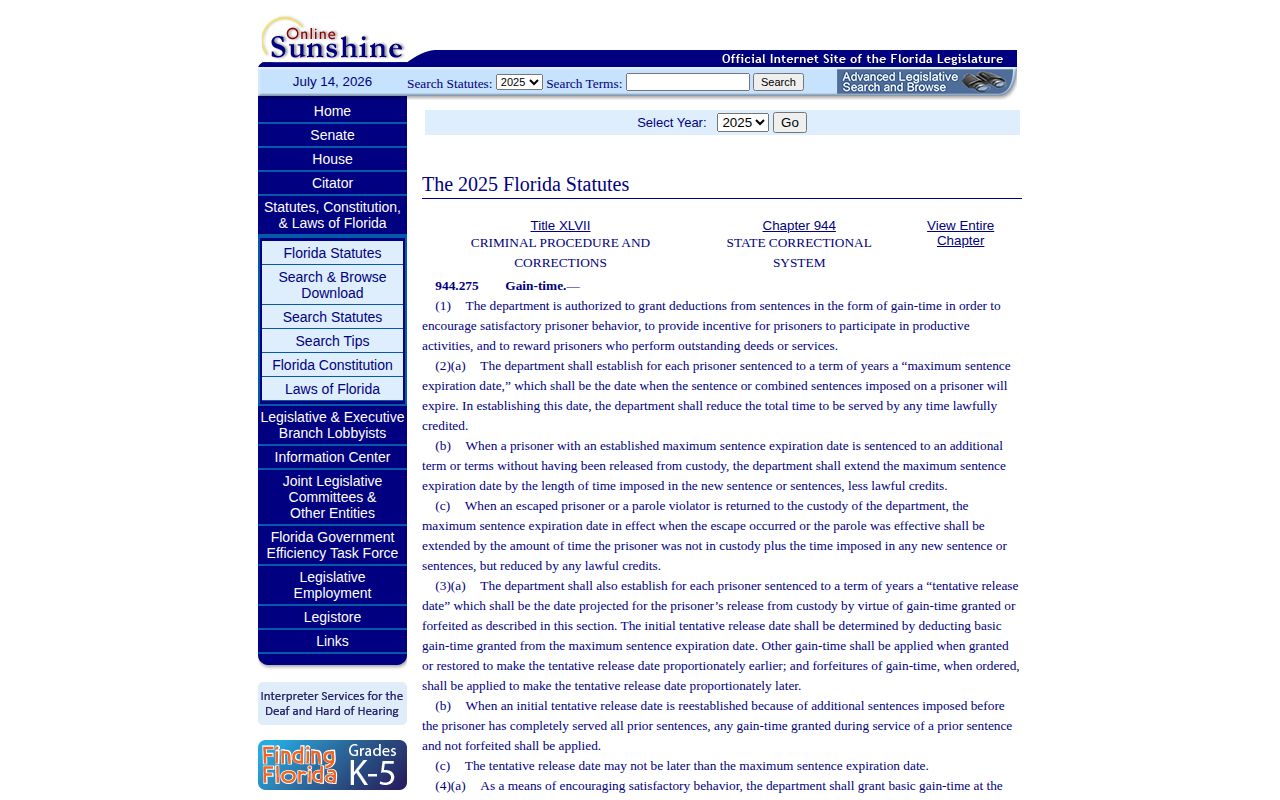
The statutory text distinguishes the maximum sentence endpoint from the tentative date affected by gain-time.
Why Lee County Release Dates Change
A projected release is a calculation from the records then on file. New orders, corrected credit, discipline, or another sentence can alter those inputs. Some events change the date itself. Others leave the sentence date in place but change whether the person returns to the community or transfers to another authority.
| Factor | Possible effect on release | Best confirmation |
|---|---|---|
| Corrected judgment or jail credit | Moves the computed date earlier or later | Court order and updated FDC or LCSO calculation |
| Gain-time award, restoration, or forfeiture | Adjusts FDC's tentative date within statutory limits | Current FDC record or calculation record |
| Consecutive or later sentence | Can extend custody beyond an earlier date | Judgments, sentence structure, and agency record |
| Mandatory minimum | Blocks an earlier gain-time date | Sentencing order and governing law |
| Detainer or transfer | May move the person to another custodian rather than the community | Release destination and receiving agency |
| Court or authorized release action | Can alter the expected custody endpoint | Signed order and completed release record |
An escape or parole-violation interval may extend the maximum date under the statute. Administrative work also can affect the time needed to execute a lawful release or transfer. Neither fact justifies guessing an exact hour from a date-only field.
Lee County Jail Release Calculations
FDC's gain-time field does not answer when a person will leave Lee County Jail. A pretrial detainee has no final sentence from which to compute gain-time. The operative event may be bond, recognizance release, dismissal, a plea and sentence, transfer, or a hold from another authority.
For a sentenced local inmate, obtain the judgment and sentence through the Lee Clerk court search. Note the jail credit and whether terms run at the same time or one after another. Then ask LCSO for the official local custody calculation. Research did not establish a Lee County rule that copies FDC's ten-days-per-month incentive formula, so that statewide formula must not be applied to a local jail term.
If the sentence commits the person to FDC, the systems hand off responsibility. LCSO records a county transfer or release movement. FDC receives commitment documents and lawful credit, assigns a DC number, and computes the state date. Use the case number and DC number to reconcile both records.
A detainer also changes how the expected event should be described. It can cause the person to leave one agency and enter another agency's custody on the same day. The first agency may correctly show released, yet there may be no return to the community. Read the release destination and then check the receiving authority before making travel or pickup plans.
For the full county custody trail, the Lee County released inmate record search connects the LCSO booking entry with the Clerk disposition and state record.
Note: A location move among Downtown Jail, Core, and CPU is not a release because all three use one LCSO custody system.
Lee County Parole Date Limits
A tentative prison date should not be translated into a parole hearing. Florida largely ended ordinary parole eligibility for offenses committed on or after October 1, 1983, subject to limited exceptions and older cohorts. FCOR still handles parole, conditional release, conditional medical release, and other categories within its authority, but eligibility is case specific.
When an FDC or court record points to FCOR, check the Commission Voting Schedule and agenda. A scheduled item proves only that a matter is set for consideration. It does not prove release was granted. The signed Commission Action or order supplies the outcome and any effective date or later review.
A person may leave prison and enter supervision. That institution release date is not the same as discharge from legal control. The community-supervision record can show the type, status, office, and termination information after prison custody ends.
Lee County Release Calculation Records
When the public FDC result does not explain a date, submit a narrow public-records request with the DC number. Ask for the sentence structure and release-date calculation, inmate release information, or discharge document that addresses the issue. FDC's public-records office lists James Best as custodian at 501 South Calhoun Street, Tallahassee, FL 32399, with assistance at 850-717-9774.
For a Lee County jail date, use the LCSO Arrest Search for the booking entry, then request the custody or release calculation through LCSO Central Records and the judgment from the Lee Clerk. The booking number identifies the jail episode. The case number identifies the judicial record. These are not interchangeable with a DC number.
Ask for the exact field definition when a code is unclear. A narrow request is more likely to isolate the needed record and cost. Florida's public-records law permits exemptions and redaction, so missing private material should not be replaced with an inferred date.
For FDC release questions, the Bureau of Admission and Release lists 850-488-9167 and dc.release@fdc.myflorida.com. Classification and Central Records lists 850-488-9859 and central.classification@fdc.myflorida.com. Use the DC number and ask whether the question concerns a tentative date, sentence calculation, completed release, or discharge. The distinction helps the office route the request to the record that can answer it.
Confirm Lee County Actual Release
Recheck the agency record when the projected date nears. FDC's Inmate Population data refreshes weekly except release dates and location changes, which update nightly, while the Inmate Release database updates nightly. Those are statewide FDC schedules, not a promise about LCSO's web cadence.
Florida VINE can send a custody-change notice for Lee County jail or FDC custody. Registration is tied to a person and custody record. A transfer can produce a different record, and an alert can be delayed or corrected. The Lee County VINELink inmate search explains how to register and confirm the event.
Final confirmation comes from the completed LCSO or FDC release entry and, when needed, a direct agency record. Preserve the exact status, date, time, destination, and update label. “Not found” does not mean released, and “out of custody” from one agency does not exclude another custodian.
Section 944.605 addresses FDC prerelease notice and documents at a different stage from the gain-time calculation. It can require notice of an anticipated release to specified justice agencies and provides identity-document support for qualifying Florida-born inmates. Those duties do not turn the tentative date into a guarantee. They show why release preparation and date computation must be described as related but separate processes.
Note: Use a projected date to plan a verification check, not as proof that a Lee County release has occurred.