
Lee County Release Mugshot Records
A booking photograph documents appearance during a specific booking. It may remain attached to an LCSO arrest record after the person leaves custody. The photograph does not show guilt, innocence, acquittal, dismissal, or final disposition. LCSO directs those questions to the Lee Clerk because the court docket holds the judicial outcome.
Florida Constitution article I, section 24 and Chapter 119 support access to government records, subject to exemptions. Public record does not mean every photo must remain on a web page forever. Online display, agency retention, and legal disclosure are distinct. Juvenile, sealed, expunged, confidential victim, medical, security, and identifying information can be restricted or redacted.
Use the booking number, booking date, agency, and case number to keep an image in context. A person can have several bookings and several photographs. A state prison image tied to a DC number is also a different record from an LCSO booking photo, even when both show the same person.
Find Lee County Released Booking Photos
Choose the channel that created or lawfully maintains the image. The LCSO booking record is the best match for a Lee County arrest. FDC is the source for a state offender photograph. Specialized registries apply only to people within their statutory scope.
| Channel | Has a photo? | How to access |
|---|---|---|
| LCSO Arrest Search | Yes, when the released booking detail displays one | Search Recent Releases or In Custody: No, then open the booking |
| LCSO Central Records | Available by request when public and maintained | Request the image by person, booking number, and date |
| Official sheriff app | Arrest search is verified; display is not guaranteed | Use the official app as a mobile doorway to arrest search |
| FDC offender record | Commonly includes a state offender photograph | Match the DC number and released state-prison record |
| FDLE specialized registries | Optional image or thumbnail for covered registrants | Search only when the person fits the registry's legal scope |
| VINE | Not a dependable photo archive | Use for custody status and notices, then confirm at the source |
| News or other publishers | Sometimes | Treat as a lead and verify against LCSO, FDC, and the Clerk |
The LCSO Arrest Search capture shows the official county release interface where a booking image may appear.
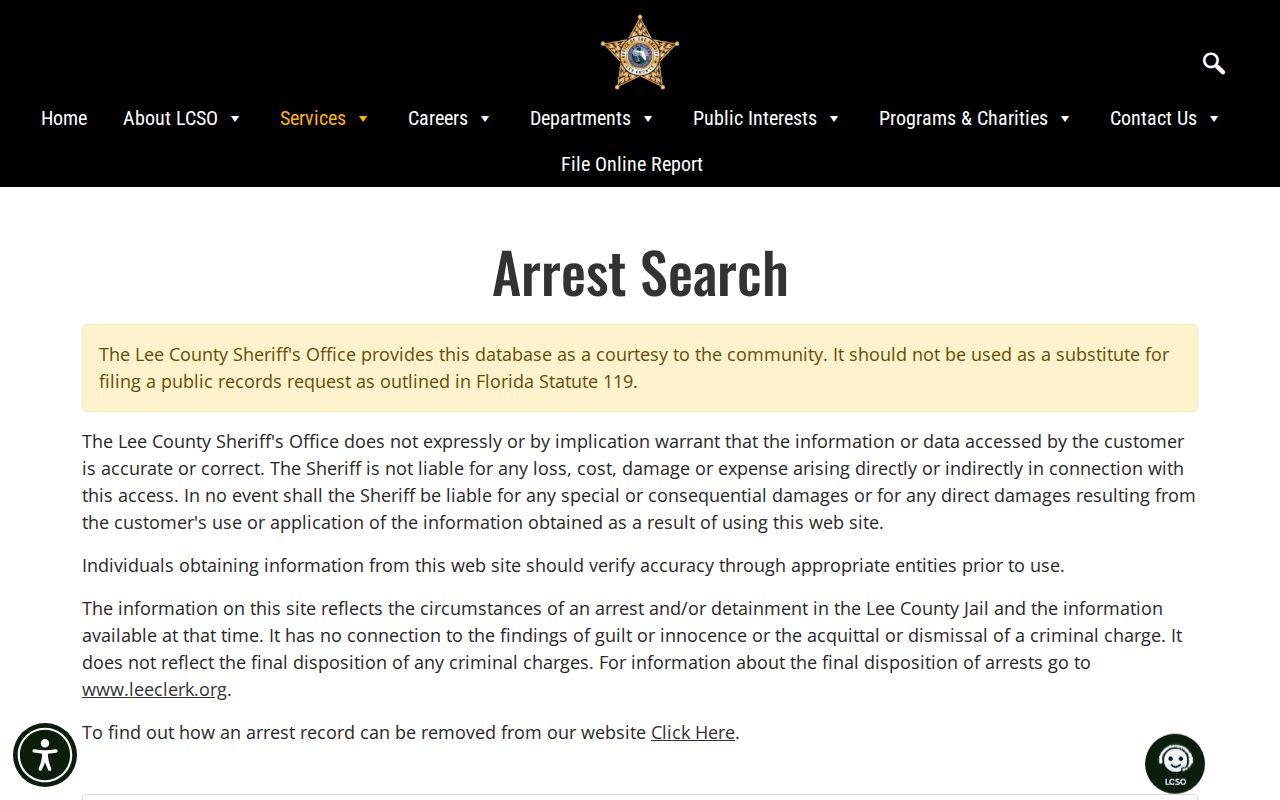
The booking detail ties a displayed image to release status, charges, bond information, and a specific booking rather than to a stand-alone gallery.
Lee County Release Photos Online
LCSO's Arrest Search has Recent Releases, an In Custody: No filter, and a Release Date Range. Search by name, date of birth, or booking number, then open the matching booking. Results identify name, date of birth, booking, and status. The expanded record can display a booking JPEG with release date and time, charges, arresting agency, bond, court, and case details.
Do not treat absence from the live-custody view as proof of release. Use release filters. Likewise, do not promise that every historical booking keeps a public image. The database has archival reach, but LCSO publishes no fixed online retention period for records or photographs. Central Records is the fallback for a missing older image.
The official LCSO app listing verifies arrest search. It does not verify a separate release-photo module, a 24-hour or 72-hour selector, or a guaranteed photo on every record. The app is another way into agency arrest information, not a second release feed. The Lee County 24-hour jail release search explains how to check timestamps within the agency's date filters.
Note: Multiple bookings for one person are separate events, so match the booking number before treating any image as the intended release photo.
Request Lee County Release Mugshots
LCSO Central Records accepts requests through its official portal or at 14750 Six Mile Cypress Parkway, Fort Myers, FL 33912/33913. The division lists 239-477-1350 and weekday hours from 7:00 a.m. to 5:00 p.m., with the lobby opening at 8:00 a.m. It is closed weekends and most major holidays.
- Find the exact LCSO booking. Record the full name, date of birth if known, booking number, and booking date.
- Use the LCSO public-records channel. Ask for the original electronic booking photograph and public metadata that ties it to that booking.
- If release context is also needed, request the custody record, recorded release date and time, and release code or destination.
- Ask for an estimate before authorizing costs. Narrow the request if extensive staff or technology work is proposed.
- Use the Lee Clerk separately for the final case disposition or a court order affecting access.
LCSO's July 2025 schedule lists $2 for a photograph, 15 cents for a single-sided page, $1 for a certified copy, and possible extensive-service charges after the first 15 minutes. A 50 percent deposit may be requested. No fixed response time is published. Section 119.07 permits a special service charge when a request requires extensive resources.
The official Central Records capture shows the Lee County booking-photo request channels.
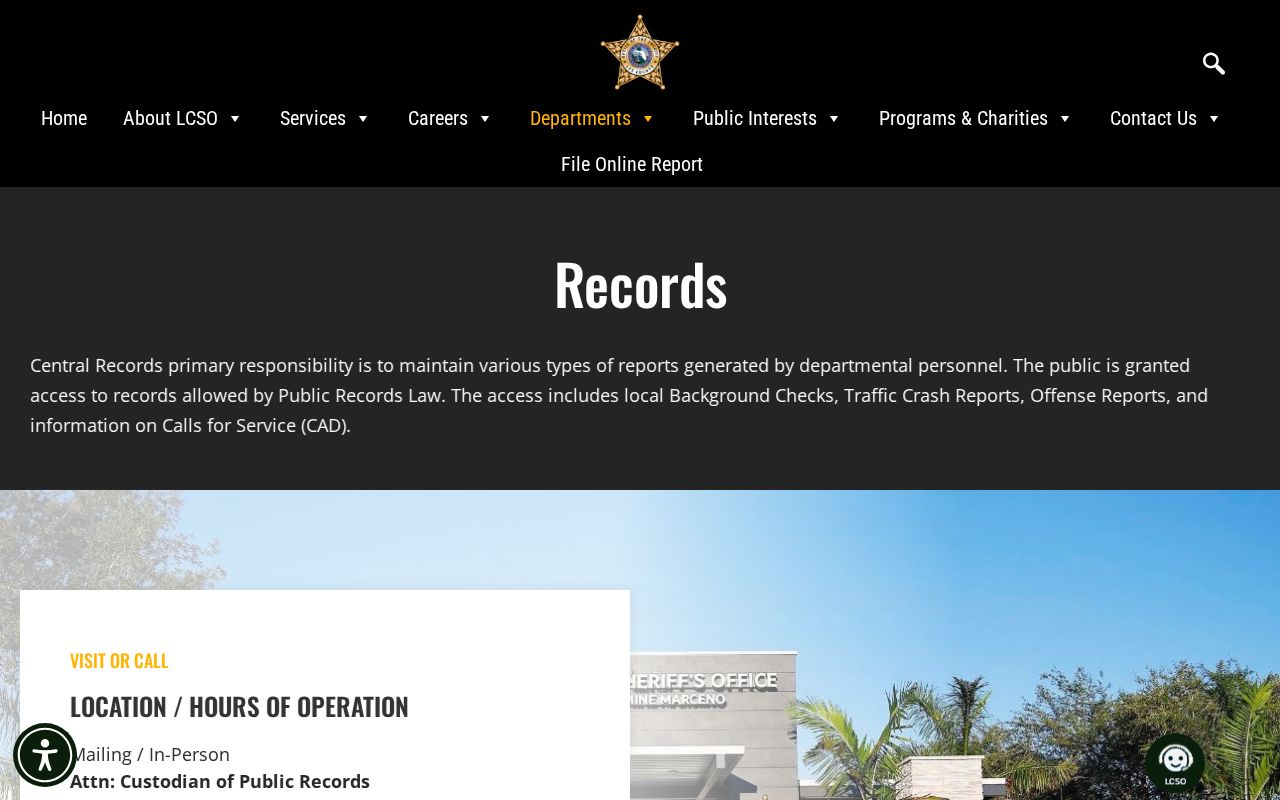
The office can supply the agency image when it is public and maintained, while the Clerk supplies the judicial record.
Lee County State Release Photos
For a person released from Florida state prison, use the FDC Corrections Offender Network. A released state record can retain the DC number, photograph, physical descriptors, offense and sentence information, and release details. Search All Corrections Offender Databases when it is unclear whether the person is incarcerated, released, supervised, or listed as an absconder.
Match the DC number first. Then compare the name, aliases, physical description, image, offense, and county. A photograph is helpful but should not override mismatched identifiers. The state image can have been taken years after an LCSO booking photo, so label it as an FDC image rather than a Lee County jail mugshot.
The FDLE Sexual Offender/Predator Search and Career Offender Registry also offer thumbnail or image options. Their status fields can include released or supervised categories, but those registries cover narrow legal groups. An ordinary Lee County release cannot be inferred from presence or absence there.
The Career Offender Registry can be searched by name and geography and may display a thumbnail for a qualifying designated career offender. The Sexual Offender/Predator Search can distinguish Released, FDC Supervision, DJJ Supervision, U.S. Probation, Absconded, Confinement, Deceased, and Deported statuses. Preserve the exact registry status. Neither database is a substitute for the LCSO released-booking detail when the question concerns an ordinary county arrest.
Each photo channel should be dated and named. That small step keeps a state offender portrait, county booking image, and registry thumbnail from being treated as one record.
Florida Release Mugshot Removal Law
Florida Statutes section 901.43 limits certain commercial booking-photo practices. A covered business may not solicit or accept payment to remove a booking photograph. The person shown or a legal representative can send a qualifying written request by registered mail to the publisher's registered agent with enough identity and photo detail.
A covered publisher must remove the photograph without charge within ten calendar days after receipt and may not republish it. Injunctive relief, civil penalties, fees, costs, and deceptive-practice remedies can apply. The statute has qualifications tied to payment conduct or a primary commercial booking-photo business model.
This is not a blanket order for LCSO to erase all images after ten days. Official records remain governed by Chapter 119, exemptions, court orders, and agency policy. Concerns about LCSO data should go to Central Records. A covered commercial publisher follows the statutory request route.
Lee County Expunged Release Mugshots
Sealing or expungement is a court process, not an automatic result of release or dismissal. Lee County's local sequence begins with an FDLE Certificate of Eligibility. After receiving it, the applicant files the certificate, petition, and affidavit with the Clerk. The Clerk advises allowing 24 to 48 hours for processing, then coordinating a hearing with the assigned judge's assistant and filing a Notice of Hearing.
The Lee Clerk sealing and expunging instructions list a $42 filing fee. FDLE lists a separate $75 application payment and commonly reports processing of 12 weeks or more. Eligibility and relief depend on Florida law, case history, and court discretion. Neither fee purchases an assured outcome.
When a signed order affects public access, use the official LCSO removal link or Central Records route and provide the order. Keep this judicial process distinct from section 901.43, which addresses covered commercial publishers. A prior public screenshot should not be reused once the source record has been lawfully restricted.
For a complete released booking and court trail, use the Lee County released inmate search to match the booking number with the Clerk case before starting any correction request.
Note: Correct identity or booking metadata with the office that created the record and provide the conflicting official evidence.