
Fort Myers Academy Transition
Fort Myers Academy is a Florida Department of Juvenile Justice moderate-risk residential commitment program. Commitment is a court-ordered placement after juvenile disposition. It differs from secure detention before adjudication or placement. DJJ owns the academy, while Rite of Passage, Inc. operates the program. Neither status makes the academy part of the adult Lee County Sheriff booking system.
A youth can complete a residential phase and move into individualized transition or aftercare, transfer to another authorized placement, or remain subject to juvenile probation and court terms. Aftercare means services or supervision following the residential phase. A move out of the academy does not necessarily end the DJJ case. The official DJJ academy listing provides the public facility contact, while case facts require authorized access.
| Question | Record source |
|---|---|
| Is the youth still at the academy? | Academy or assigned DJJ contact after authorization |
| What transition did the court approve? | Juvenile court, counsel, or juvenile probation |
| Does supervision continue? | DJJ probation or aftercare contact |
| Is the youth on the adult release list? | No; the LCSO adult search does not cover this placement |
Confirm Academy Release Records
Use existing case documents first. A parent, guardian, attorney, or other permitted person may have the disposition order, case plan, assigned juvenile probation officer, and contact instructions. Gather the youth’s legal name, date of birth, case number if known, and proof of the caller’s relationship or authority. Staff may need those facts before discussing even basic placement information.
- Review the latest juvenile court and DJJ paperwork for the assigned case and probation contacts.
- Call the academy or case contact and state the caller’s authorized role.
- Ask whether the residential placement continues, changed to another program, or entered approved transition or aftercare.
- Confirm the controlling date and conditions from the most recent court or DJJ document.
- Follow reporting, transportation, treatment, school, or placement directions supplied for that youth.
Do not substitute a program capacity, age range, or general description for a personal release date. Individual timing depends on the court order, case plan, DJJ decisions, program progress, and authorized transition arrangements. Only the case team can confirm the current plan.
Academy Records Stay Confidential
Juvenile confidentiality sets a firm boundary. Public copy must not name youth, display photographs, or assemble academy releases. A person with lawful access should use DJJ, counsel, juvenile probation, or the juvenile court. The Lee Clerk records information notes that confidential case categories are restricted, even though it also offers request paths for records that are public.
Access can vary by record and role. A parent may receive information through a route unavailable to an unrelated caller. Counsel may obtain case documents subject to the governing rules. Staff can explain the process without disclosing protected facts. If authority is uncertain, ask what identification or written permission is required rather than trying an adult booking search.
- Disposition
- The juvenile court’s order following adjudication or another case resolution.
- Commitment
- A DJJ residential placement ordered by the court.
- Aftercare
- Structured support or supervision following residential placement.
- Confidentiality
- Limits on general public access to youth identity and case information.
Confidential does not mean unrecorded. DJJ and the juvenile court maintain records for their legal and operational roles. It means the information is routed to people with authority, not placed in a public adult-style list.
Fort Myers Academy Facts
DJJ lists Fort Myers Academy as a 28-bed moderate-risk residential program for female youth ages 13 through 18. “Moderate-risk” is the agency’s program classification, not an adult security label. The academy is state-owned and operated under contract by Rite of Passage, Inc. Those facts describe the program. They do not establish the status of any individual youth.
The image below is drawn from the official DJJ program page.
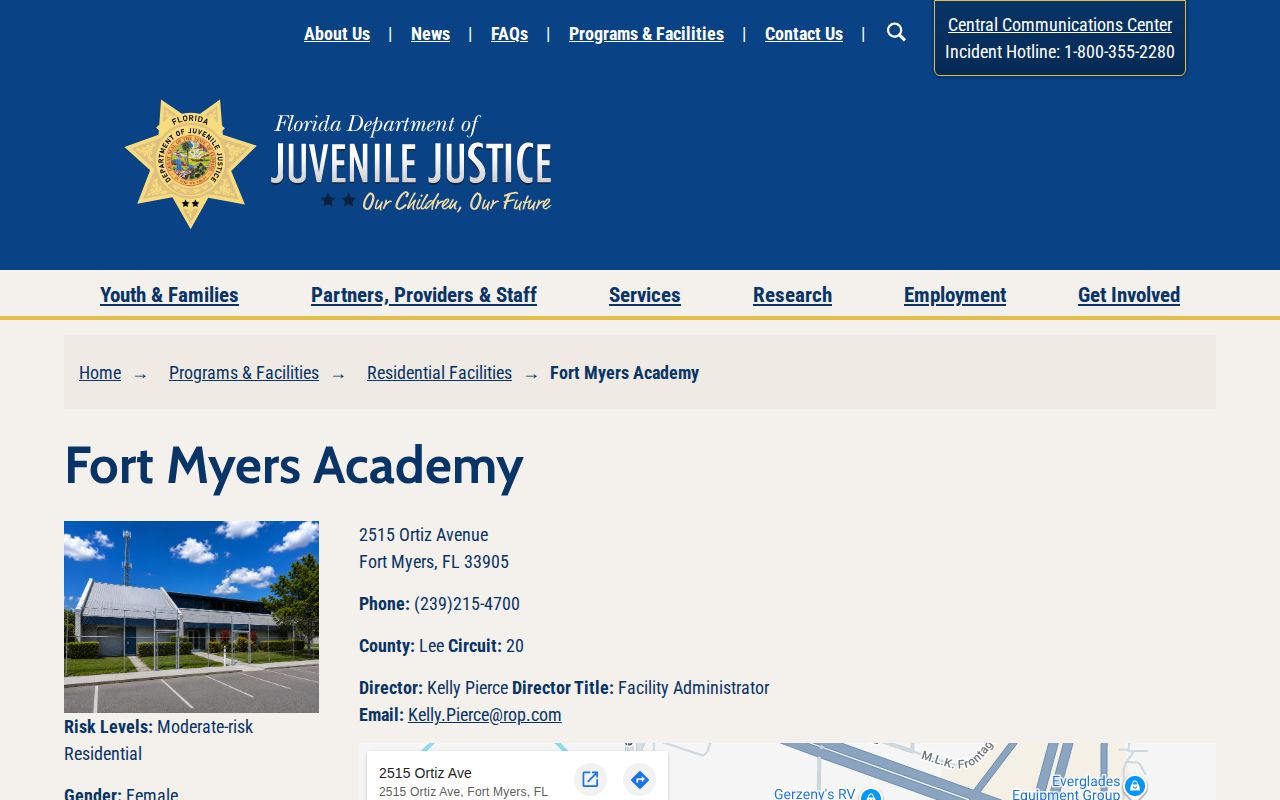
The official page confirms the public facility facts and contact route. It does not authorize publication of youth names or case status.
The academy address is 2515 Ortiz Avenue in Fort Myers. Its location next to other correctional and juvenile buildings can cause confusion. Always pair the address with the program name and DJJ responsibility before asking about a transition.
Ortiz Academy Records Differ
The Ortiz corridor includes the adult LCSO Core Facility and Community Program Unit, the DJJ regional juvenile detention center, and Fort Myers Academy. Their close addresses do not merge records. The adult sites use LCSO booking data. The secure juvenile detention center holds youth pending juvenile case or placement decisions. The academy is a residential commitment program after a court disposition.
The LCSO Corrections page identifies the adult units. DJJ pages identify the juvenile facilities. A youth who moves from the regional center to the academy has changed program type, not entered the adult jail system. A youth who leaves the academy for aftercare may still have DJJ supervision.
Ask three basic questions: Which building? Which agency? What court or DJJ document controls? Those questions prevent an adult Arrest Search query from being used for a confidential juvenile placement. They also prevent a transfer between youth programs from being called a community release. Note: A nearby Ortiz address does not prove shared custody or shared record access.
Academy Aftercare Confirmation
Aftercare is not one standard result. The case plan may include juvenile probation, treatment, education, family services, or another approved arrangement. The authorized person should obtain the current written directions, confirm the receiving person or placement, and note the next contact or reporting obligation. If the plan changes, rely on the latest agency or court direction.
Transportation and handoff details are case-specific. Public facility information does not identify a release door, routine hour, or family waiting area. Do not infer those details from the address. Ask the case contact where, when, and to whom the youth may be released. That direct confirmation protects the youth and avoids a missed transition.
The Lee County release and facility overview distinguishes adult LCSO, DJJ detention, DJJ residential commitment, and assessment functions. It is useful for agency routing, but it does not replace the confidential case record or the assigned DJJ team.
Fort Myers Academy Contact
DJJ lists Fort Myers Academy at 2515 Ortiz Avenue, Fort Myers, Florida 33905. The published telephone number is 239-215-4700. Callers should expect identity and authority checks before staff discuss an individual youth. General facility facts can be public even when placement status is not.
2515 Ortiz Avenue
Fort Myers, FL 33905
239-215-4700
DJJ residential commitment program
Ask how an authorized parent, guardian, attorney, or agency contact confirms a transition or aftercare plan. Do not request a public youth list. For the legal order, use counsel or the juvenile court. For the active case plan, use the assigned DJJ or probation contact. These sources provide the most accurate, lawful answer.
When staff cannot discuss a youth with the caller, ask for the process to prove authority or reach the assigned case team. Record the office name and general instructions without pressing for protected facts. A case number, legal name, and birth date may help route the request, but the agency decides which identifiers and permissions are required.
Keep “left the academy” separate from “discharged from DJJ.” Physical transition can occur before aftercare or probation ends. The court order and DJJ case record establish whether legal supervision continues. If the youth moved to another program, the receiving placement becomes the contact for current information. This chain is more accurate than any public adult release search.
Academy Transition Record Checks
Save the latest lawful transition notice and assigned contact details. If dates change, ask the case team which written direction now controls before arranging a handoff. Compare the date on each notice with the active court or DJJ direction. A projected program milestone is not the same as an approved transition date, and an approved move does not by itself show that aftercare ended.
Ask the assigned contact to identify the next responsible office. If another residential program receives the youth, use that program for current placement questions. If the youth begins community aftercare, retain the juvenile probation contact and written reporting terms. A family member should confirm who may receive the youth and what documents are needed before travel.
Program staff, DJJ, juvenile probation, counsel, and the juvenile court answer different parts of the record. Use the academy for current program routing, the case team for transition, and the court for its order. Keeping those roles separate protects confidentiality and reduces the risk of treating a tentative plan as a completed release.