
Lee County Release Records Explained
A release from the Lee County Sheriff’s Office, or LCSO, means that agency no longer holds the person on that booking. It does not always mean a return to the community. The person may have posted bond, completed a jail term, received a court order, moved to another LCSO unit, or transferred to the Florida Department of Corrections, another county, a federal agency, or immigration custody. An internal move between the Downtown Jail, Core Facility, and Community Program Unit is not a release.
Lee County released inmates leave a chain of records. The LCSO Arrest Search records the county custody movement. The Lee Clerk docket supplies the judicial reason and later disposition. Florida Department of Corrections, or FDC, records control a state-prison release and later state supervision. VINELink relays alerts from a participating custodian, but it is not the source ledger. These records must be read together when one result says only “not in custody.”
| Release event | What it means | Next record |
|---|---|---|
| Bond or recognizance | The person left jail while the case continues. | Lee Clerk case docket and any pretrial conditions |
| Time served | The recorded confinement ended. | Judgment, sentence, and any other holds or supervision |
| Transfer | One custodian released the person to another. | Receiving county, FDC, BOP, or ICE source |
| Prison release | FDC incarceration ended, though supervision may remain. | FDC release and community-supervision records |
| Case dismissal | The court ended a charge; it is not inferred from jail release. | Entered Clerk order and sealing guidance if applicable |
Fields in Lee County Release Records
The LCSO search form accepts first, middle, and last name, date of birth, booking number, custody choice, booking dates, and release dates. Results show name, birth date, booking, and status. An expanded released booking can add the release date and time, booking photograph, housing, charge, arresting agency, bond, court, case, and hearing details. The precise live fields should be copied as shown because LCSO does not visibly promise one universal release-reason field.
| Field | What it shows |
|---|---|
| Booking number | The identifier for one arrest and custody episode |
| Custody status | Whether LCSO holds the person on that record now |
| Release date and time | When the LCSO movement out of custody was recorded |
| Facility or housing | The unit tied to the booking, not proof of discharge by itself |
| Charge and case number | The bridge to the Lee Clerk’s judicial file |
| Bond fields | Bond type, amount, or payment data when displayed |
| Photograph | An image tied to the arrest event, not the final case result |
A “No” custody value proves only that LCSO is not holding the person on that booking at the time of the query.
The official Arrest Search interface shows why the release-date and custody filters matter.
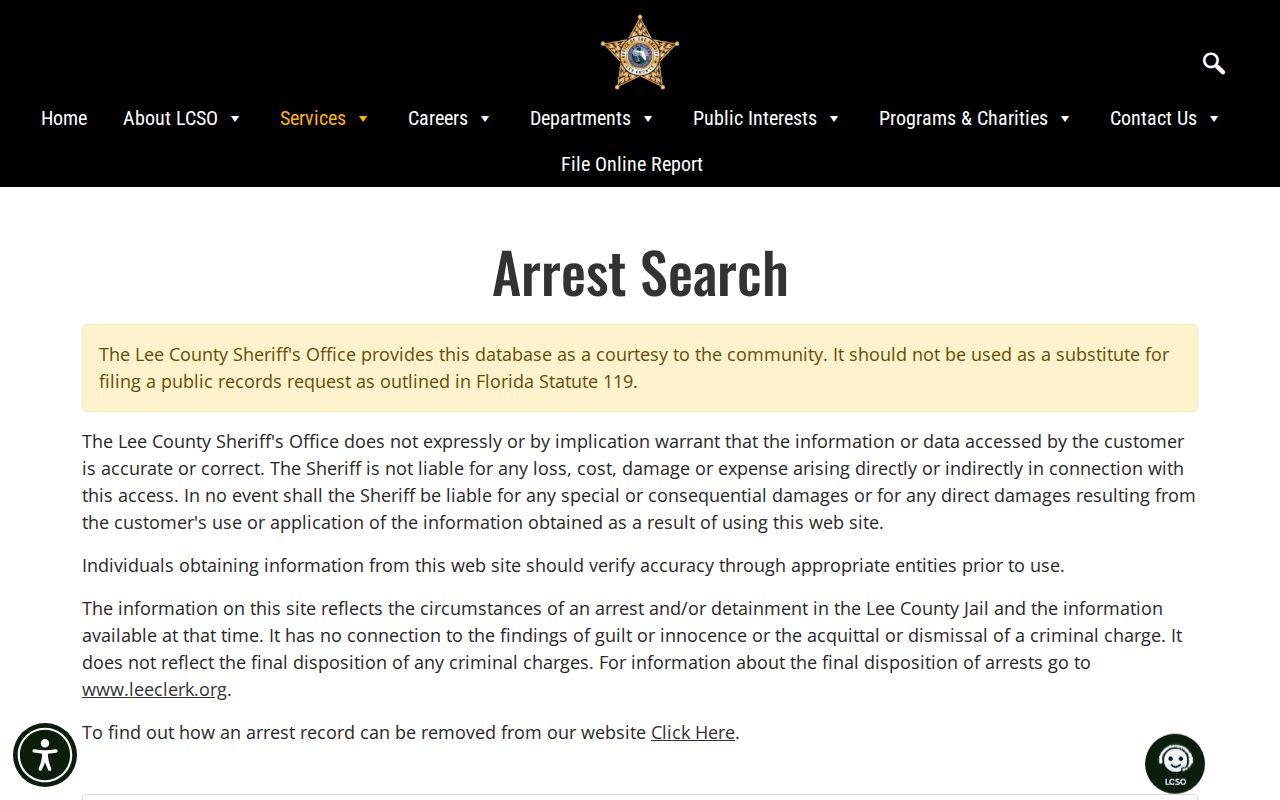
The county interface reaches past the live jail roster, but LCSO does not promise a fixed online retention period.
Request Lee County Release Records
When an older record is missing or a release code is unclear, request the source document from LCSO Central Records. The listed custodian is Cherrie McAbee, Director of Central Records Division. Central Records is at 14750 Six Mile Cypress Parkway, Fort Myers, Florida 33912/33913, and the telephone number is 239-477-1350. Published service hours are Monday through Friday from 7:00 a.m. to 5:00 p.m.; the lobby opens at 8:00 a.m. Weekends and most major holidays are closed.
- Identify the person with full name, date of birth if known, booking number, and an approximate booking or release date.
- Ask for the jail booking and custody record, recorded release date and time, release type or destination, and any needed booking photograph.
- Request a code legend if the response uses an unfamiliar movement code. Do not ask records staff to decide the legal effect of a court order.
- Ask for a cost estimate before approving a broad search or large file. No fixed response time is published.
- Use the case number with the Lee Clerk for the judgment, dismissal, sentence, or termination order.
LCSO’s July 2025 schedule lists $0.15 for a single-sided page, $0.20 for a duplex page, $2 for a photograph, $1 for a certified copy, and $5 for a CD or flash disc. Shipping varies. Extensive work may be charged at the listed staff or technology rate after the first 15 minutes, and a 50-percent deposit may be requested. Florida Statutes § 119.07(4)(d) permits a special service charge when a request consumes extensive technology, clerical, or supervisory resources.
The LCSO records page displays the official request channels and office details.
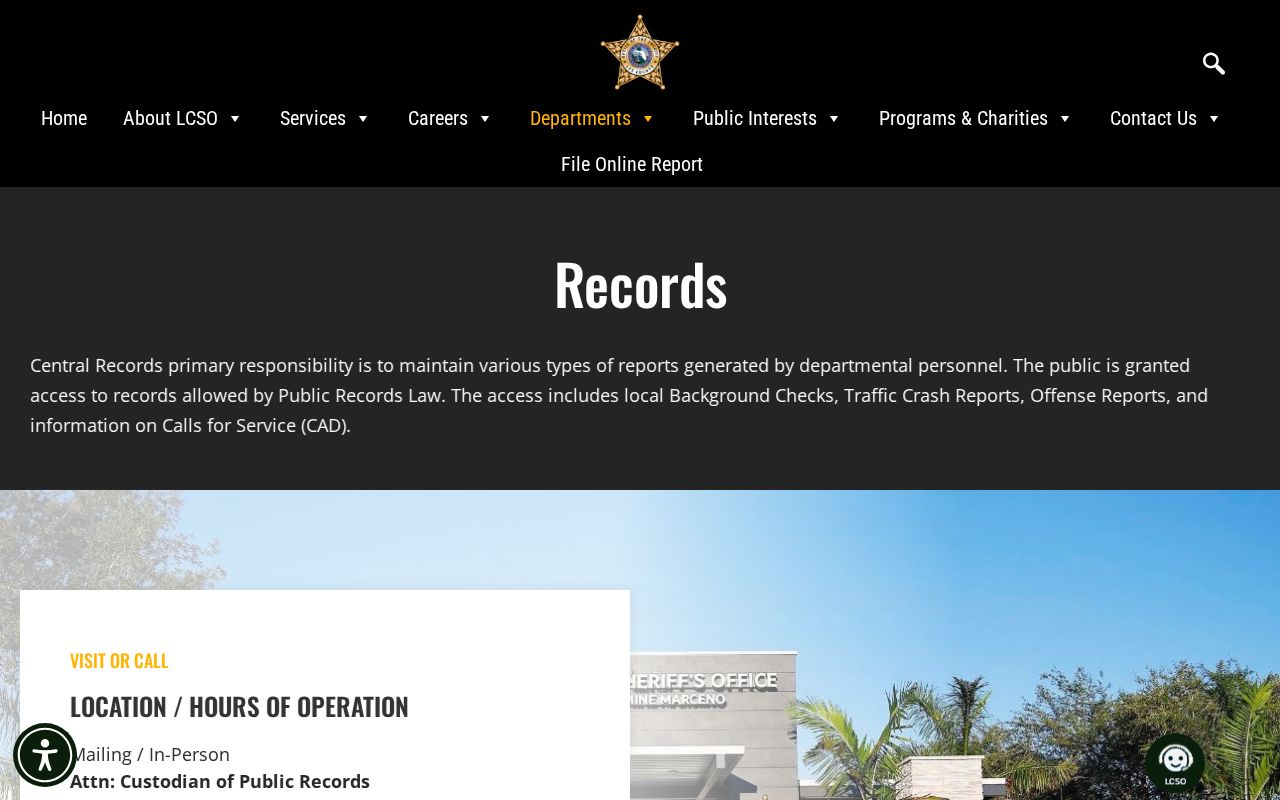
A narrow request tied to one booking is easier to route and separates the jail movement from the court’s legal disposition.
Note: Florida public access is broad, but juvenile, sealed, expunged, victim, medical, security, and identifying information may be withheld or redacted.
Find Lee County Released Inmates
A named-person search starts with the custody system that most likely held the person. A person released only from an LCSO jail belongs in the county search, not the state prison database. A Lee County defendant sent to a state prison will have an LCSO transfer event and a separate FDC reception and release trail. Federal sentenced prisoners use the Bureau of Prisons locator. ICE uses its own short-window locator.
- Open LCSO Arrest Search. Select Recent Releases, or use name, date of birth, booking number, In Custody: No, and a Release Date Range.
- Open the booking. Record the exact status, release time, case number, charge, bond data, and any destination that the detail actually displays.
- Search the case number or party name in the Lee Clerk system. Read filed orders and the docket instead of treating an arrest label as final disposition.
- If the booking shows transfer or a state sentence, search all FDC databases by DC number or full identity.
- Use BOP for a federal prison term and ICE only when immigration custody is plausible. A no-result does not prove community release.
- Send a focused request to the office that created the missing record when public web results remain unclear.
A released person often drops off a live custody roster, so use release-date filters and the originating agency’s release record.
Lee County Release Court Lookup
The Lee Clerk Court Records Search is the durable bridge between a booking release and the case outcome. Enter *** in First Name to search by last name only, or put * after part of a name for a partial match. Results stop at 500, so narrow a common-name query by date and case type. Adult Felony and Misdemeanor are common choices, though Criminal Traffic and Detention Hearing records may also matter.
Open the docket and public documents. Look for bond or recognizance orders, pleas, adjudication, judgment and sentence, jail credit, FDC commitment, dismissal or nolle prosequi, probation, violation filings, warrants, revocation, and termination or satisfaction orders. Some images require Viewable on Request. Many older records, including numerous pre-2004 cases, and restricted documents use the Clerk’s request channel. Juvenile and other confidential cases must stay within their access rules.
Note: A booking record describes arrest and custody; an entered court order supplies the authoritative disposition for the criminal case.
Florida Release Offender Search
The Florida Corrections Offender Network separates inmate population, inmate release, community supervision, and absconder or fugitive data. Search All Corrections Offender Databases is the safest start when the person’s status is uncertain. A DC number is the strongest identifier. Name, alias, physical description, photo, offense, county, and sentence fields help distinguish similar names.
| FDC route | Use it for | Important limit |
|---|---|---|
| Inmate Population | A person in Florida state custody now | Not the archive for an LCSO-only booking |
| Inmate Release | A completed FDC incarceration release | Supervision may still continue |
| Community Supervision | Probation, parole, conditional release, and related statuses | Use the listed office for official procedure |
| Absconder/Fugitive | An FDC allegation of lost contact or noncompliance | It is not proof of a new conviction |
| Current Release Date | The current tentative date on a population record | It can change and is not proof of actual release |
FDC says Inmate Release updates nightly. Its population and supervised databases generally refresh weekly, with release dates, termination dates, and location changes updating nightly. Those are FDC schedules, not an LCSO promise. For a completed release, read the release detail and exact status rather than relying on an older projected date.
The official FDC released-inmate detail demonstrates the state’s release and Date Out-Custody fields.
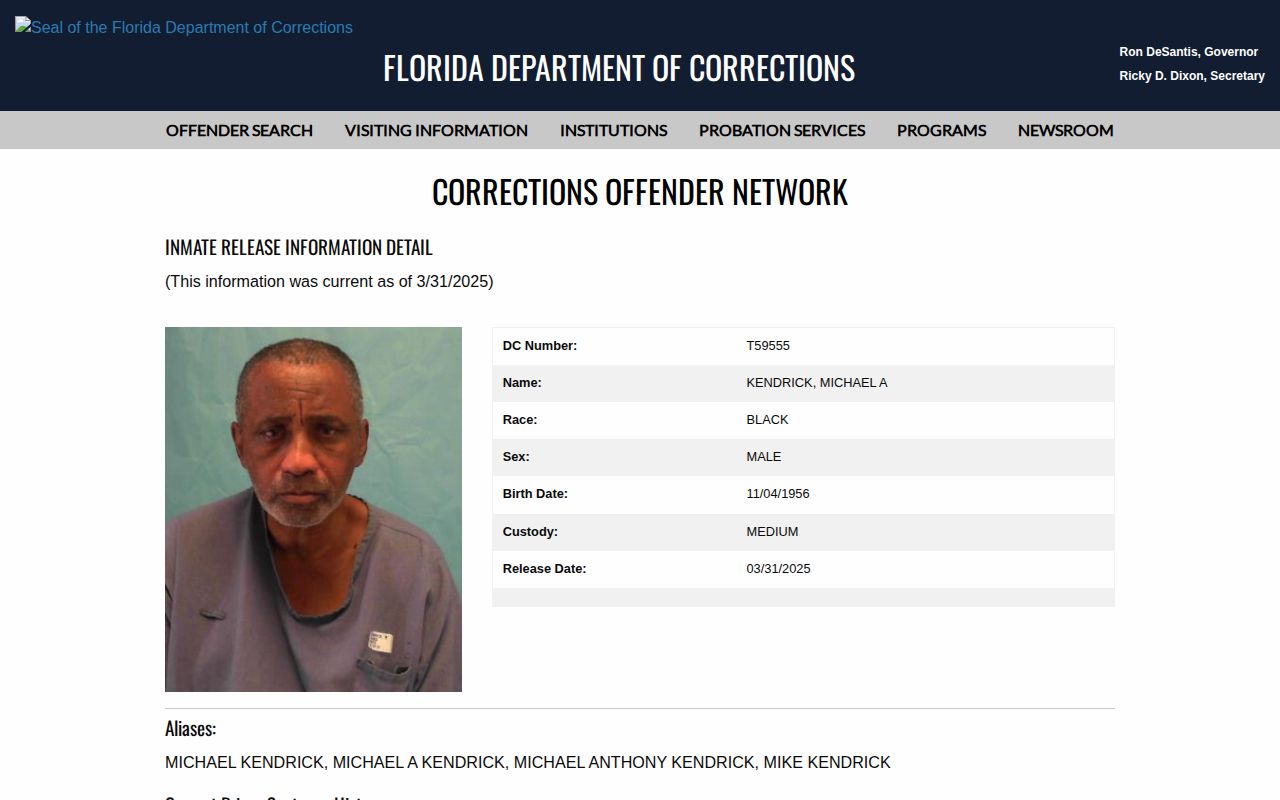
The completed state record is distinct from LCSO’s county booking and from a current FDC population page.
Lee County Recent Release Search
LCSO provides one official Arrest Search with a Recent Releases control, not two separate agency feeds labeled 24 hours and 72 hours. A one-day or three-day task uses the Release Date Range and then checks the timestamp inside each booking. The Recent Releases shortcut uses calendar dates in the live page code, so its span is not guaranteed to equal a rolling number of elapsed hours. LCSO also publishes no binding refresh or web-retention schedule.
For a same-day release, allow for booking-system lag and verify with the agency or Florida VINE. For a weekend or holiday, use an inclusive date range and inspect each result to avoid a midnight-boundary miss. Multiple bookings for one person are separate custody episodes. A release on one booking does not prove that another booking or outside hold ended.
When Lee County Jail Releases Happen
Lee County publishes no fixed daily discharge hour. LCSO says a time-served release should take minimal time, while release on recognizance or another court order may take several hours. The jail cannot act until the complete court paperwork arrives, and the court may send that package near the end of its business day. No official source confirms a special weekend schedule, release door, or public waiting point.
This makes the recorded release time more useful than an estimated pickup time. LCSO also states that bonds are processed first come, first served. Cash bond, fine, or purge payments require the exact amount, while a surety bond must use an authorized agent registered with the Clerk and LCSO. No current Lee-specific monetary bail schedule was verified, so case-level amounts should come from the booking and court file.
Getting Home After Lee County Release
Lee County Pretrial Services says a released person is afforded a phone call to arrange transportation. LeeTran Route 5 serves the Ortiz Avenue corridor, but neither LCSO nor LeeTran names a jail release stop or family waiting area. Check the current LeeTran map and schedule and service alerts before travel. Corridor service does not prove where a particular person exits.
Because no public discharge point is confirmed, families should not use a transit stop as proof of where a person will emerge. The released person’s call and current transit information are the documented planning tools.
Lee County Pretrial Bond Release
Lee County Pretrial Services can supervise an eligible defendant released without posting a money bond. Orientation, regular reporting, and court-ordered conditions may continue through case disposition or until the court changes them. This is a community release from jail, not the end of the criminal case.
LCSO separately states that cash bond, fine, or purge payments require the exact amount. A surety bond must come from an authorized bond agent registered with the Lee Clerk and LCSO, and bonds are processed first come, first served. No current Lee County monetary bail schedule was verified, so the booking and court record should supply the case-level amount.
Lee County Release Property and ID
For property secured after arrest, Lee County’s official Pretrial Services material directs the person to the arresting agency or Lee County Jail at 239-477-1500. That is a routing instruction, not a guarantee that each item is returned at the release door. The booking agency and jail should confirm the correct pickup route for the property in question.
Property and identification are separate tasks. A person may need the arresting agency for stored property while using a reentry program for help replacing identity papers.
Lee County Release Reentry Support
LCSO’s Re-Entry Case Management Program describes help with identification, birth certificates, Social Security cards, treatment referrals, Social Security benefit reinstatement, bicycles, emergency kits, clothing, and other basic needs for people approaching release. The Community Program Unit also provides reentry and alcohol or drug treatment programming.
These services support transition but do not locate a released person. Program participation or completion is not proof of discharge. The LCSO booking release entry, court file, and any supervision record still control those questions.
Lee County Release and ICE Custody
LCSO entered Task Force Model and Warrant Service Officer 287(g) agreements with ICE in March 2025. Under the Warrant Service Officer model, trained local officers may serve or execute administrative warrants on people already in agency custody. A recorded exit from LCSO may therefore be followed by immigration custody instead of community return.
No separate ICE detention-services contract or ICE facility at the Lee jail was verified. When facts point to an immigration handoff, use the ICE Online Detainee Locator. It accepts a nine-digit A-number with country of birth or exact biographical details. ICE states that the system includes current detainees and people released from ICE custody within the last 60 days, excludes juveniles, and can omit some records. It is not a permanent release archive.
Lee County Release Record Law
Florida Constitution article I, § 24 and Chapter 119 establish public access subject to exemptions. Florida Statutes § 119.07 governs inspection, copies, fees, exemptions, and special service charges. A record may be public without being indexed online. Web display duration, agency retention, and legal disclosure are separate questions.
Official web display is not the same as the agency’s retention duty. A sealing order, exemption, or access rule can change public visibility without rewriting the earlier custody event.
Lee County Release Expungement Steps
Sealing and expungement are not automatic after release or dismissal. Lee County’s local path starts with an FDLE Certificate of Eligibility. The person then files the certificate, Clerk petition, and affidavit, allows 24 to 48 hours for Clerk processing, coordinates a hearing with the assigned judge’s assistant, and files a Notice of Hearing.
The Lee Clerk instructions list a $42 filing fee. FDLE lists a separate $75 application, certified dispositions, any required probation-termination proof, fingerprints, and prosecutor certification for an expunction. FDLE reports a typical 12 weeks or more, while eligibility and relief remain subject to law and court discretion.
Fees After Lee County Release
LCSO’s Corrections FAQ lists a $50 booking or processing fee and certain incurred charges. Unpaid balances can move to collections after 30 days. This is an after-release financial rule, not a fee that must be paid before every discharge. Other listed items can include medical service, damaged property, registration, indigent kits, copies, religious items, or related jail services.
If every charge is dismissed, LCSO provides a 30-day procedure for requesting a refund of the $50 fee. The person brings an official sealed Clerk document to the Core Building. A release entry alone does not show that all charges were dismissed, so the court record must support the request.
Lee County Release Supervision Checks
Release from confinement and discharge from legal supervision are different events. FDC Community Corrections supervises probation and many post-prison statuses. The Florida Commission on Offender Review handles parole, conditional release, conditional medical release, and other matters within its jurisdiction. Modern Florida sentences generally do not include ordinary discretionary parole, so a tentative release date should not be called a parole hearing.
Florida VINE covers FDC and all 67 county jails, including Lee County. Search at Florida VINELink or call 1-877-846-3435. A notice reflects data supplied by the custodian and can describe release, transfer, or another custody change. Verify the event in LCSO or FDC. For a federal sentenced prisoner, use the BOP Inmate Locator; “Released” or “Not in BOP custody” resolves BOP custody only.
- Probation
- Court-ordered community supervision, sometimes imposed without a prison term.
- Parole
- A limited Florida release category chiefly tied to eligible older cohorts and specific laws.
- Discharge
- The end of the legal term or supervision described by the issuing agency.
- Detainer
- A request or authority that can cause transfer to another custodian.
Special Lee County Release Registries
Official registries answer narrow statutory questions, not the general released-inmate question. FDLE’s Sexual Offender and Predator Search can filter for Released, FDC supervision, DJJ supervision, U.S. Probation, absconded, confinement, civil commitment, deceased, and deported statuses. The Career Offender Registry covers only people who meet that law’s designation. An absence from either registry says nothing about an ordinary Lee County release.
Lee County Ordinance 23-30 also created a limited Animal Abuser Registry. A covered person must register within ten business days after release, or after judgment when not incarcerated. The public search may show name, date of birth, address, and charges, but it applies only to specified local convictions on or after December 5, 2023. It must not be presented as a county release list.
Lee County Release Facility Paths
Three adult LCSO units share one countywide booking and release record. The juvenile sites use Florida Department of Juvenile Justice channels and confidentiality rules. The correct system follows the building’s operator and the kind of placement.
- Lee County Jail: LCSO Arrest Search, Central Records, then the Clerk or receiving custodian.
- Lee County Core Facility: the same countywide LCSO booking record, not a separate Core roster.
- Lee County Community Program Unit: the LCSO release entry plus any court or supervision record.
- Southwest Florida Regional Juvenile Detention Center: DJJ and juvenile court channels for authorized people.
- Fort Myers Academy: individual DJJ transition, aftercare, probation, and court channels.
- Lee County Juvenile Assessment Center: an assessment or booking route; secure detention moves into DJJ custody.
Note: No current adult FDC prison was found in Lee County; a state-sentenced defendant may be housed elsewhere in Florida.
Ortiz Lee County Release Systems
The Ortiz Avenue corridor contains adult LCSO Core and CPU functions, the Southwest Florida Regional Juvenile Detention Center, and Fort Myers Academy at nearby addresses. Physical proximity does not place each person in the adult Sheriff database. LCSO and DJJ run distinct custody systems.
A youth’s detention or residential transition follows DJJ, juvenile probation, and juvenile court rules, including confidentiality limits. The adult LCSO Arrest Search cannot prove a youth’s release, and no public youth release list should be built from it.